C41
Kodak Portra 400
Kodak Portra 400 is a professional C-41 color negative film known for flexible exposure latitude, natural skin tones, and fine grain.
View profileMedium Format TLR
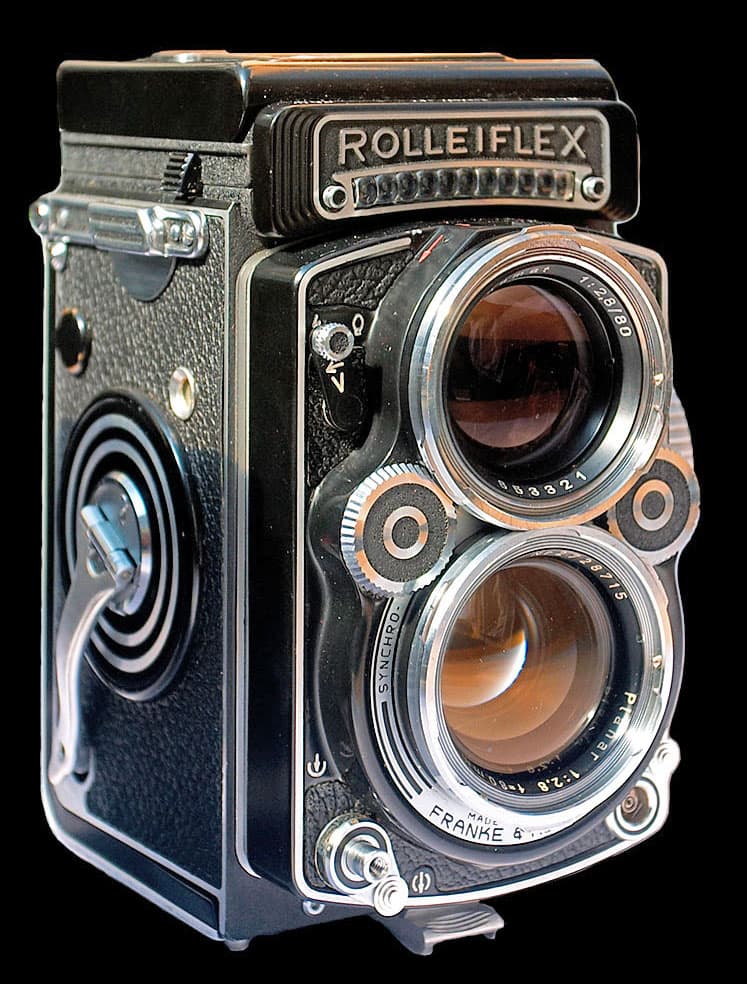
The 2.8F is a 6×6 medium-format twin-lens reflex, the late-production peak of the Rolleiflex line. Two matched lenses — a viewing lens for composition, a taking lens for the negative — sit in a fixed front plate. You compose looking down into a bright glass finder, focus by turning a knob, and trip the leaf shutter for a 12-shot roll of 120 film. The taking lens is either a Carl Zeiss Planar 80/2.8 or a Schneider Xenotar 80/2.8 — both excellent, both prized.
Reference
Recommended film stocks for the — format your camera takes.
C41
Kodak Portra 400 is a professional C-41 color negative film known for flexible exposure latitude, natural skin tones, and fine grain.
View profileBW
Kodak Tri-X 400 is a classic black-and-white film known for strong tonality, visible grain, and documentary character.
View profileBW
Ilford HP5 Plus is a flexible ISO 400 black-and-white film with classic grain and strong push-processing tolerance.
Develop — film
We're growing the lab directory near you. Browse all labs.
Before you buy used
About this camera
The TLR. Square negatives, waist-level finder, and the camera Vivian Maier wore around her neck for forty years.
| Field | Value |
|---|
| Format | 120 (6×6 cm) |
| Taking lens | Zeiss Planar 80/2.8 or Schneider Xenotar 80/2.8 |
| Viewing lens | Heidosmat 80/2.8 |
| Years | 1960–1981 (multiple sub-versions) |
| Shutter | 1s – 1/500s + B, Synchro-Compur leaf |
| Flash sync | All speeds |
| Meter | Selenium uncoupled (early); CdS on later White Face / GX |
| Weight | 1,250 g |
The Rolleiflex line traces back to 1929. The 2.8F is the final 1960s revision of the f/2.8 series, succeeding the 2.8E. Sub-versions during the 21-year run added meter changes (selenium → CdS), accessory shoes, and the rare "White Face" cosmetic finish (1980, ~5,000 units). The line was succeeded by the FX/GX (1980s–2010s) reissues and continues today in low-volume manufacturing.
The 2.8F has carried more weddings, Vogue covers, and street photographs than any other medium-format camera. The waist-level finder makes you slow down and compose deliberately; the square frame removes the orientation decision; the leaf shutter is silent enough to use anywhere. The Planar/Xenotar lenses produce a "pop" — high microcontrast, smooth transitions in skin — that defines the look of post-war portrait photography.
Vivian Maier shot a Rolleiflex (2.8 Automat / 3.5 / various models including 2.8F) for the entirety of her career; her self-portraits in storefront windows, with the camera at her stomach, are now the iconic visual reference for the format.
Lens is fixed. Accessory ecosystem:
Many photographers still use the original split-prism focusing screen; later screens (Beattie Intenscreen, Maxwell) offer brighter focus aids.
C41
Kodak Portra 160 is a professional C-41 color negative film with fine grain, soft contrast, and natural color.
View profileBW
Fujifilm Neopan 100 Acros is an ultra-fine-grain ISO 100 black-and-white negative film celebrated for its world-class granularity, wide tonal range, and exceptional reciprocity characteristics. The original Acros was discontinued in 2018; Acros II relaunched in November 2019 with a reformulated emulsion and is the current production version.
View profile