C41
Kodak Portra 400
Kodak Portra 400 is a professional C-41 color negative film known for flexible exposure latitude, natural skin tones, and fine grain.
View profileMedium Format SLR
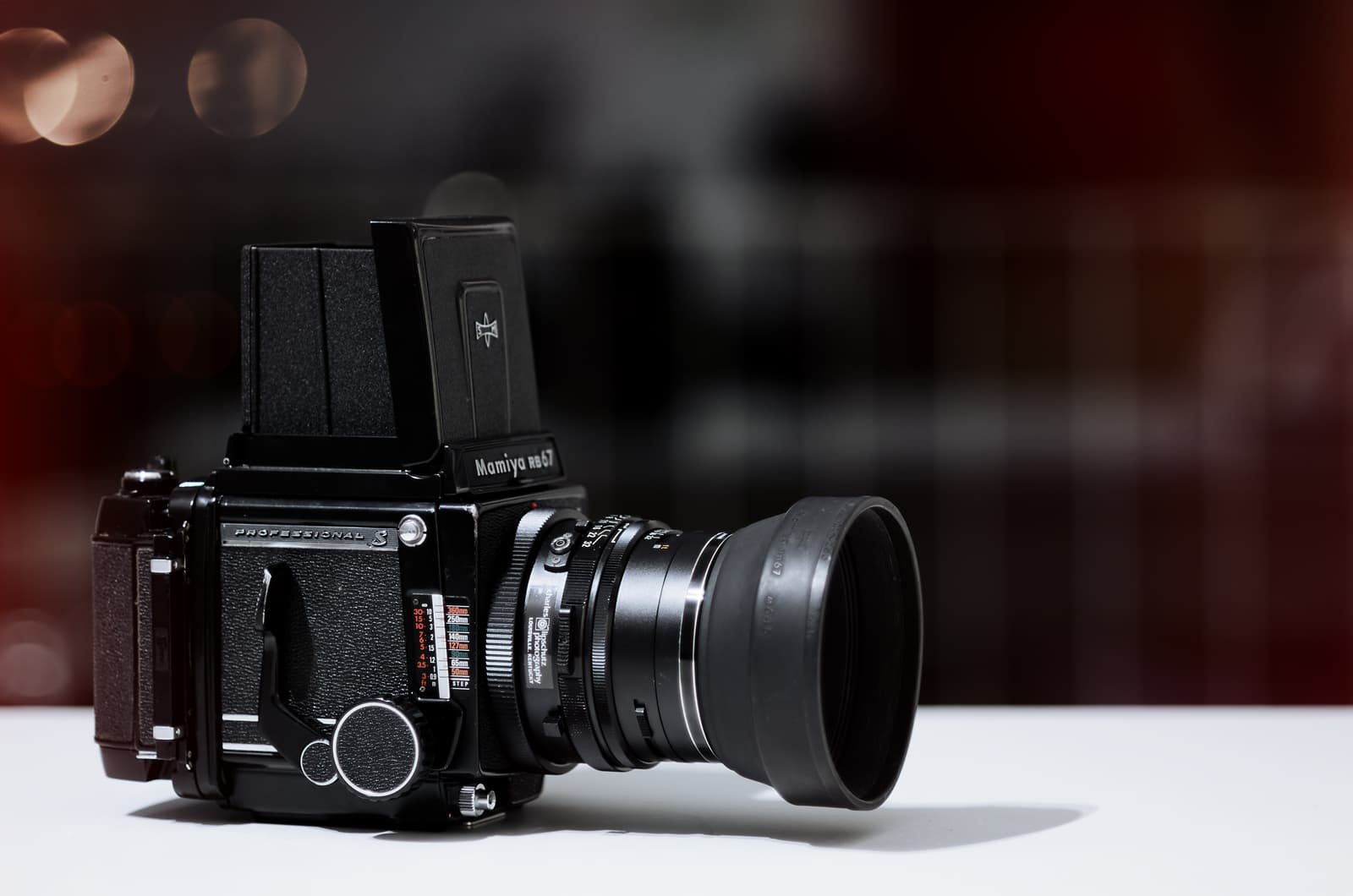
The RB67 Pro-S (1974) added incremental refinements to the original 1970 RB67 — most notably an **improved multi-exposure interlock** that lets you decouple the body's wind sequence to make multiple exposures on a single frame, and a brighter focusing screen. The body remained mechanical, the rotating back unchanged, and the bellows focus unchanged. Same Seiko leaf shutters in each lens, same flash sync at all speeds, same 2.7 kg weight.
Reference
Recommended film stocks for the — format your camera takes.
C41
Kodak Portra 400 is a professional C-41 color negative film known for flexible exposure latitude, natural skin tones, and fine grain.
View profileC41
Kodak Portra 160 is a professional C-41 color negative film with fine grain, soft contrast, and natural color.
View profileC41
Kodak Ektar 100 is a fine-grain C-41 color negative film with saturated color and high sharpness.
Develop — film
We're growing the lab directory near you. Browse all labs.
Before you buy used
About this camera
The 1974 refinement of the RB67. Multi-exposure interlock, brighter screen, and same 6×7 rotating-back workflow.
| Field | Value |
|---|
| Format | 120 / 220, 6×7 cm (10 frames per 120 roll) |
| Mount | Mamiya RB |
| Years | 1974–1990 |
| Shutter | 1s – 1/400s + B, Seiko leaf, in each lens |
| Flash sync | All speeds |
| Meter | None (AE prism finder optional) |
| Modes | Manual |
| Weight | 2,700 g |
| Battery | None |
Released 1974 as the mid-life refresh of the original RB67. The Pro-S ran 16 years until the Pro-SD (1990, refined K/L lenses, slightly larger throat) replaced it. Together with the original Pro and the later Pro-SD, the RB67 line spanned 35 years — among the longest-running medium-format SLR designs.
The Pro-S is the most-recommended RB67 variant for users buying today. The improved multi-exposure interlock makes it more flexible than the Pro, and it's significantly cheaper than the Pro-SD (which has slightly newer lenses but otherwise the same workflow). Most "Mamiya RB67" listings on the used market are Pro-S bodies.
For 2026 buyers, RB67 Pro-S + 90mm f/3.8 C + 120 back at $700–1,000 is one of the cheapest entries into 6×7 studio photography. The trade-off is weight (2.7 kg loaded) and the all-mechanical, no-meter, no-AE workflow.
Mamiya-Sekor C lenses (1970+, mainline). Common: 90/3.8 C (kit), 50/4.5 C, 65/4.5 C, 127/3.8 C, 180/4.5 C, 250/4.5 C. Pro-SD bodies accept the K/L lens series. Same backs and finders as RB67 Pro / RB67 Pro-SD.
E6
Fujifilm Fujichrome Velvia 50 (RVP 50) is the legendary professional E6 reversal slide film at ISO 50 that defined landscape and nature photography for a generation. Characterized by extreme saturation, deep contrast, and ultra-fine grain, it remains in active production as of 2026.
View profileBW
Ilford HP5 Plus is a flexible ISO 400 black-and-white film with classic grain and strong push-processing tolerance.
View profileBW
Kodak Tri-X 400 is a classic black-and-white film known for strong tonality, visible grain, and documentary character.
View profile