C41
Kodak Portra 400
Kodak Portra 400 is a professional C-41 color negative film known for flexible exposure latitude, natural skin tones, and fine grain.
View profileMedium Format SLR
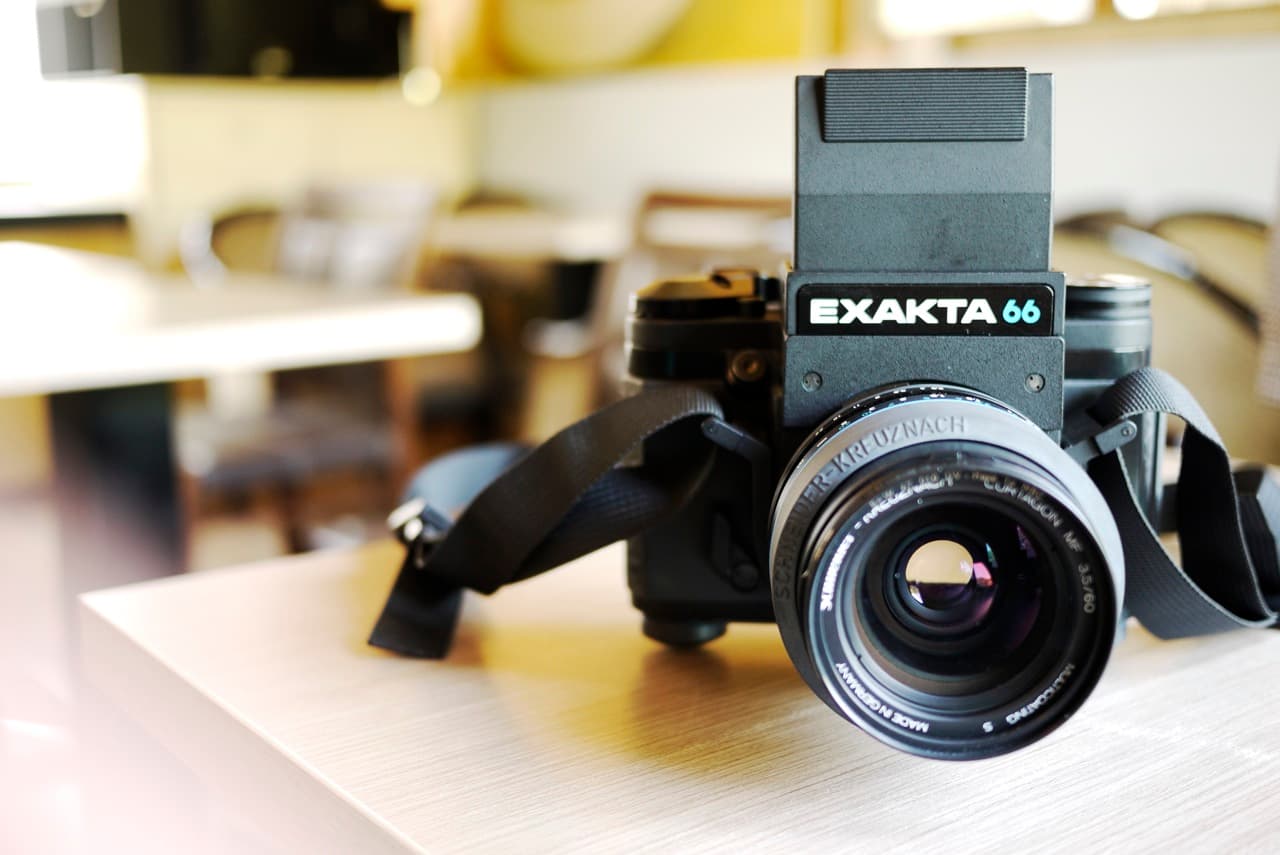
The Ihagee Exakta 66 (c. 1954) is a 6x6 cm medium-format single-lens reflex camera produced by Ihageewerk AG of Dresden, East Germany. It translates the distinctive ergonomic conventions of the 35mm Exakta Varex line - most notably the left-hand shutter release, the rotating knob film advance, and the interchangeable finder/back design philosophy - into a medium-format body taking 120 rollfilm and producing 6x6 cm square negatives.
Reference
Recommended film stocks for the — format your camera takes.
C41
Kodak Portra 400 is a professional C-41 color negative film known for flexible exposure latitude, natural skin tones, and fine grain.
View profileC41
Kodak Portra 160 is a professional C-41 color negative film with fine grain, soft contrast, and natural color.
View profileC41
Kodak Ektar 100 is a fine-grain C-41 color negative film with saturated color and high sharpness.
Develop — film
We're growing the lab directory near you. Browse all labs.
Before you buy used
The Exakta 66 appears occasionally at auction and through specialist dealers in East German cameras; it is uncommon but not as scarce as some single-production-run East German cameras.
About this camera
Ihagee's attempt to scale the Exakta's left-hand shutter release and focal-plane logic up to 6x6 medium format - a bold, quirky instrument from Dresden.
| Field | Value |
|---|
| Format | 120 (6x6 cm) |
| Mount | Exakta 66 bayonet |
| Years | c. 1954 – ~ |
| Standard lens | Carl Zeiss Jena Tessar 80mm f/2.8 |
| Metering | None |
| Battery | None required |
| Shutter | Focal-plane: ~1s - 1/1000s + B |
| Flash sync | |
| Viewfinder | Waist-level |
| Focus aids | Ground glass |
Ihageewerk AG was a Dresden camera manufacturer with roots going back to 1912 and a claim to one of the most consequential innovations in camera history: the 1936 Kine Exakta, generally accepted as the world's first practical 35mm SLR. The firm continued under East German nationalisation after World War II, producing the postwar Exakta Varex series (from 1950) alongside the older Exakta VP/Varex waist-level bodies.
The Exakta 66 represents Ihagee's ambition to extend the Exakta brand into medium format, presumably to compete with the growing reputation of Hasselblad (1948) and the Rolleiflex TLR. The choice of a focal-plane shutter distinguished the Exakta 66 from most 6x6 SLR competitors and directly echoed the Exakta 35mm design lineage. The left-hand shutter release - a defining quirk of all Exakta designs that attracted photographers accustomed to the system and puzzled everyone else - was retained in the 66 body.
Production details for the Exakta 66 are not well established in available sources. The camera appears to have been produced in limited numbers and has never achieved the collector profile of the 35mm Exakta Varex series or the Hasselblad 500C.
East German camera production in this period was managed under the VEB nationalised enterprise system; Ihagee's exact operational structure and production allocations within the Dresden camera industry are subject to ongoing historical research.
The Exakta 66 matters principally as a road not taken in 6x6 SLR design. By the mid-1950s, two competing philosophies for medium-format SLR cameras were available: the between-lens leaf shutter approach (Hasselblad 500C, 1957) and the focal-plane approach (Exakta 66). The leaf-shutter approach won commercially, primarily because it allowed flash synchronisation at all shutter speeds and because Hasselblad's modular system - interchangeable backs, finders, and magazines - offered workflow advantages that no focal-plane 6x6 SLR of the era matched.
The Exakta 66 is also a document of Ihagee's attempt to remain competitive in medium format during a period when the Dresden camera industry was being reorganised under East German state management. The VEB nationalisation process resulted in Ihagee's eventual merger with other Dresden firms and the gradual dilution of the Exakta brand. The 66 represents Ihagee still operating as an identifiable engineering entity with its own design idiom.
For collectors, the camera represents an interesting convergence: the oldest SLR brand heritage (Exakta/Ihagee) applied to medium format using the focal-plane shutter logic that made the 35mm Exakta famous.
The Exakta 66 uses its own bayonet mount, distinct from the 35mm Exakta Varex mount. Native lens options were limited:
The limited native lens range is one of the practical constraints that reduced the Exakta 66's competitive standing against the Hasselblad system, which from the beginning offered a broader and more carefully developed optic programme.
No motor drive or interchangeable magazine system was available for the Exakta 66. A waist-level finder was standard; the finder appears not to have been interchangeable in the Hasselblad sense.
E6
Fujifilm Fujichrome Velvia 50 (RVP 50) is the legendary professional E6 reversal slide film at ISO 50 that defined landscape and nature photography for a generation. Characterized by extreme saturation, deep contrast, and ultra-fine grain, it remains in active production as of 2026.
View profileBW
Ilford HP5 Plus is a flexible ISO 400 black-and-white film with classic grain and strong push-processing tolerance.
View profileBW
Kodak Tri-X 400 is a classic black-and-white film known for strong tonality, visible grain, and documentary character.
View profile