C41
Kodak Portra 400
Kodak Portra 400 is a professional C-41 color negative film known for flexible exposure latitude, natural skin tones, and fine grain.
View profileMedium Format SLR
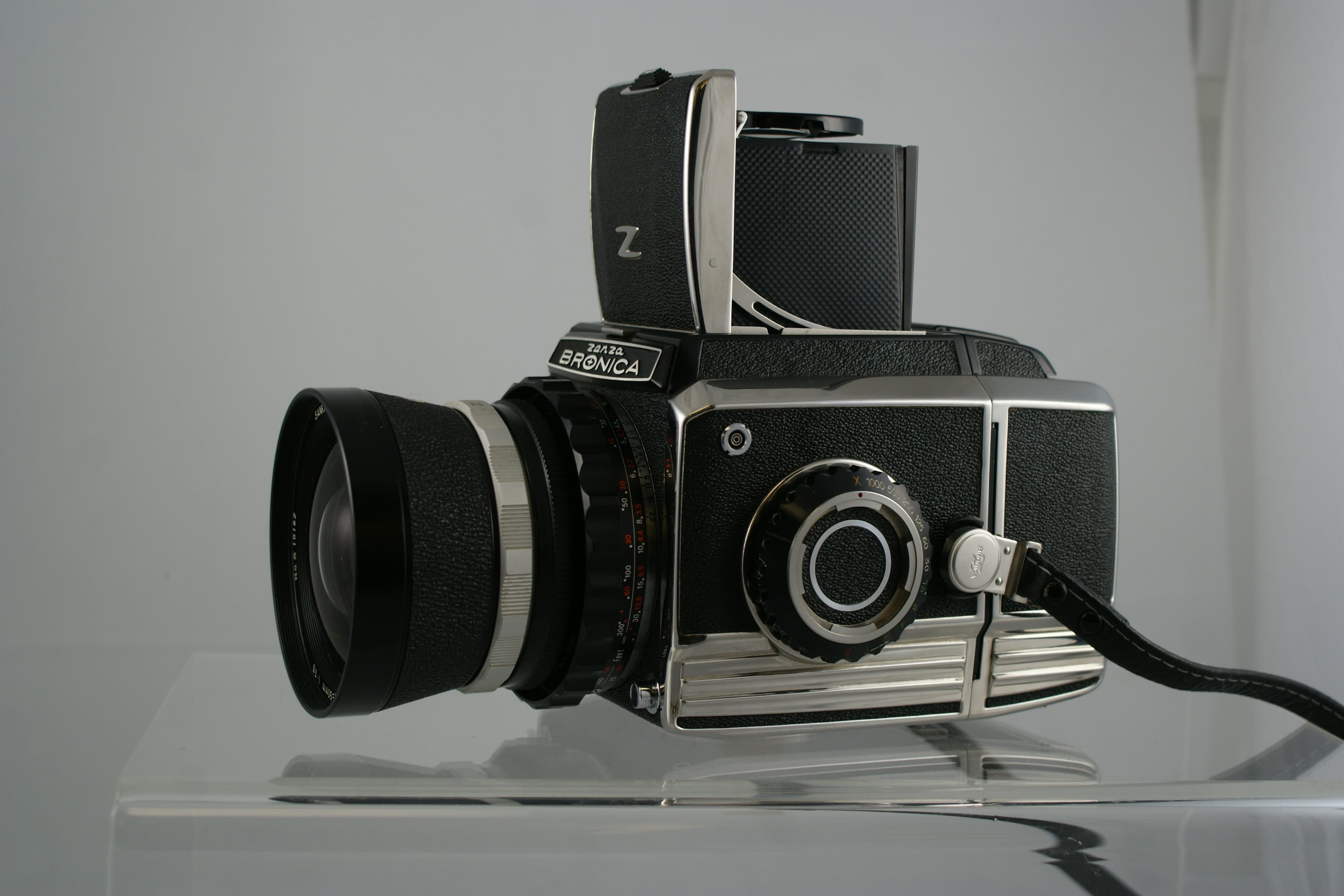
The Bronica Z is the prototype or pre-production medium-format SLR developed by Shino Zenzaburo and his team around 1958, preceding the first commercial Bronica model, the D (Deluxe, 1959). It established the fundamental design concept that would define the Bronica system: a body-integral focal-plane shutter in a 6x6 cm SLR, allowing lenses without built-in shutters to be used and making the overall system less expensive than shutter-in-each-lens competitors such as Hasselblad. The Z was not sold to the public; it served as a proof-of-concept and engineering validation unit. Very few examples are known to exist, and it is effectively a museum and collector's piece.
Reference
Recommended film stocks for the — format your camera takes.
C41
Kodak Portra 400 is a professional C-41 color negative film known for flexible exposure latitude, natural skin tones, and fine grain.
View profileC41
Kodak Portra 160 is a professional C-41 color negative film with fine grain, soft contrast, and natural color.
View profileC41
Kodak Ektar 100 is a fine-grain C-41 color negative film with saturated color and high sharpness.
Develop — film
We're growing the lab directory near you. Browse all labs.
Before you buy used
About this camera
The prototype that started Bronica - a pre-production 6x6 focal-plane SLR, built ~1958, never sold commercially.
| Field | Value |
|---|
| Format | 120 film, 6x6 cm |
| Mount | Bronica Z prototype bayonet |
| Year | ~1958 (prototype; not commercially produced) |
| Shutter | Focal-plane, rubberized cloth (speed range unverified) |
| Meter | None |
| Modes | Manual only |
| Finder | Waist-level ground glass |
| Focus | Manual, ground glass |
| Battery | None required |
Shino Zenzaburo, a Japanese engineer and entrepreneur, began developing a medium-format single-lens reflex camera in the mid-1950s. His central design decision - placing the shutter in the body rather than in each lens - was economically motivated: it allowed the use of simpler (and cheaper) lens barrels and opened the possibility of adapting existing Nikkor lenses. The prototype produced around 1958 is referred to as the Bronica Z. Mechanical problems and manufacturing refinements identified during prototype evaluation led directly to the D (Deluxe), which entered commercial production in 1959. The relationship between the Z and D is analogous to a pre-production engineering mule and its production successor: the core architecture is shared, but the D incorporated improvements in reliability and finish that made it suitable for sale. The exact number of Z units produced is unknown but believed to be in the single digits or very low tens.
The Bronica Z matters as the origin point of a camera system that challenged Hasselblad's near-monopoly on professional medium-format photography through the 1960s and 1970s. The design philosophy proven in the Z - focal-plane shutter, body-integral mechanics, adapted Nikkor glass - carried through every Bronica 6x6 body until the line ended with the EC-TL in the mid-1970s and then evolved differently in the ETR (6x4.5) and SQ (6x6 leaf-shutter) lines. For camera historians, the Z represents a moment of Japanese engineering ambition in the medium-format segment at a time when European cameras (Hasselblad, Rollei, Linhof) dominated professional work worldwide. Surviving examples are of historical rather than practical photographic interest.
E6
Fujifilm Fujichrome Velvia 50 (RVP 50) is the legendary professional E6 reversal slide film at ISO 50 that defined landscape and nature photography for a generation. Characterized by extreme saturation, deep contrast, and ultra-fine grain, it remains in active production as of 2026.
View profileBW
Ilford HP5 Plus is a flexible ISO 400 black-and-white film with classic grain and strong push-processing tolerance.
View profileBW
Kodak Tri-X 400 is a classic black-and-white film known for strong tonality, visible grain, and documentary character.
View profile