C41
Kodak Portra 400
Kodak Portra 400 is a professional C-41 color negative film known for flexible exposure latitude, natural skin tones, and fine grain.
View profile35mm SLR
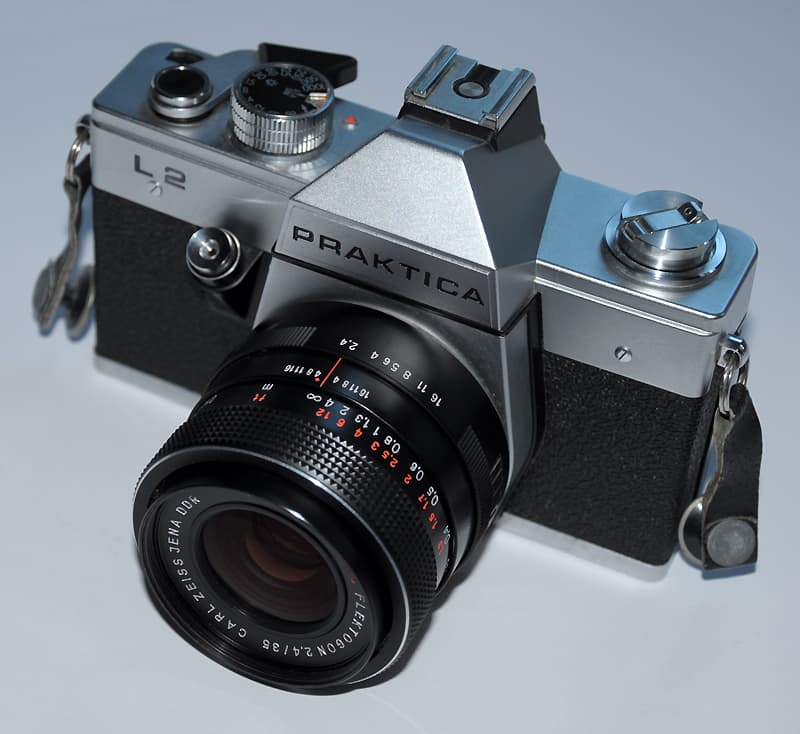
The Praktica L2 (1975) is a 35mm single-lens reflex camera produced by VEB Pentacon in Dresden, East Germany. It is a refinement of the Praktica L (1969), the model that introduced the durable vertical-travel metal focal-plane shutter to the Praktica line. The L2 carries forward the same core shutter mechanism with documented improvements to shutter reliability and durability, but omits any built-in exposure metering -- the camera is entirely manual, operating without a battery under all conditions.
Reference
Recommended film stocks for the 35mm format your camera takes.
C41
Kodak Portra 400 is a professional C-41 color negative film known for flexible exposure latitude, natural skin tones, and fine grain.
View profileBW
Kodak Tri-X 400 is a classic black-and-white film known for strong tonality, visible grain, and documentary character.
View profileC41
Kodak Gold 200 is a daylight-balanced C-41 color negative film with warm color, moderate grain, and a classic consumer-film look.
Develop 35mm film
Labs in our directory that process 35mm film.
Before you buy used
About this camera
A stripped-down East German M42 SLR with a strengthened vertical metal shutter and no meter -- pure mechanical simplicity.
| Field | Value |
|---|
| Format | 35mm (24x36 mm) |
| Mount | M42 screw (42x1 mm) |
| Year introduced | ~1975 |
| Shutter | Vertical metal focal-plane: 1s - 1/1000s + B |
| Flash sync | 1/125s (X-sync) |
| Meter | None |
| Exposure | Manual (no in-body meter) |
| Viewfinder | Pentaprism, split-prism + microprism |
| Focus | Manual |
| Battery | Not required |
VEB Pentacon developed the Praktica L family from the earlier cloth-shutter Praktica models in the late 1960s. The Praktica L (1969) was the first Praktica with a vertical metal focal-plane shutter -- a significant upgrade in durability and flash sync over the preceding horizontal cloth designs. The LLC and LTL variants introduced open-aperture and TTL metering respectively in the early 1970s.
The L2 appeared around 1975 as a direct evolution of the original L, incorporating shutter improvements accumulated from the production run of the L and the metered LTL/LLC variants. By keeping metering circuitry out of the body, Pentacon could produce the L2 at lower cost while offering a fully mechanical camera with no battery dependency. It sat at the bottom of the export product line alongside the metered MTL series.
The Praktica L2 represents the most utilitarian expression of the Praktica L philosophy: a mechanically sound, battery-free M42 body at minimal cost. For photographers seeking a fully mechanical SLR that will never fail due to dead batteries, the L2 is a practical choice. The vertical metal shutter is significantly more robust than the horizontal cloth shutters found in many comparably priced cameras of the era, and its M42 mount opens access to some of the finest optics of the postwar German industry.
Today the L2 appeals primarily to M42 lens collectors and film photographers who want an inexpensive, dependable host body. Because the camera carries no meter circuitry, there are fewer electronic failure modes compared with metered siblings like the LTL3 or MTL3.
The M42 screw mount accepts any M42/Pentax-thread lens. Recommended pairings from the East German catalogue: Carl Zeiss Jena Tessar 50/2.8 (compact, sharp standard), Pancolar 50/1.8 (fast standard, good wide-open character), Flektogon 35/2.4 (wide-angle workhorse), Sonnar 135/3.5 (telephoto). From Meyer-Optik Görlitz: Oreston 50/1.8, Domiplan 50/2.8, Trioplan 100/2.8. The L2 also accepts M42 extension tubes, bellows units, and slide-copying attachments for close-up work.
C41
Fujifilm Superia X-TRA 400 (marketed as Superia 400 in some regions) is an ISO 400 C-41 consumer color negative film in 135 format, one of Fujifilm's most popular consumer films. It delivers warm, vibrant colors with moderate grain and remains in production in some markets.
View profileBW
Ilford HP5 Plus is a flexible ISO 400 black-and-white film with classic grain and strong push-processing tolerance.
View profileC41
Kodak Ektar 100 is a fine-grain C-41 color negative film with saturated color and high sharpness.
View profile