C41
Kodak Portra 400
Kodak Portra 400 is a professional C-41 color negative film known for flexible exposure latitude, natural skin tones, and fine grain.
View profile35mm SLR
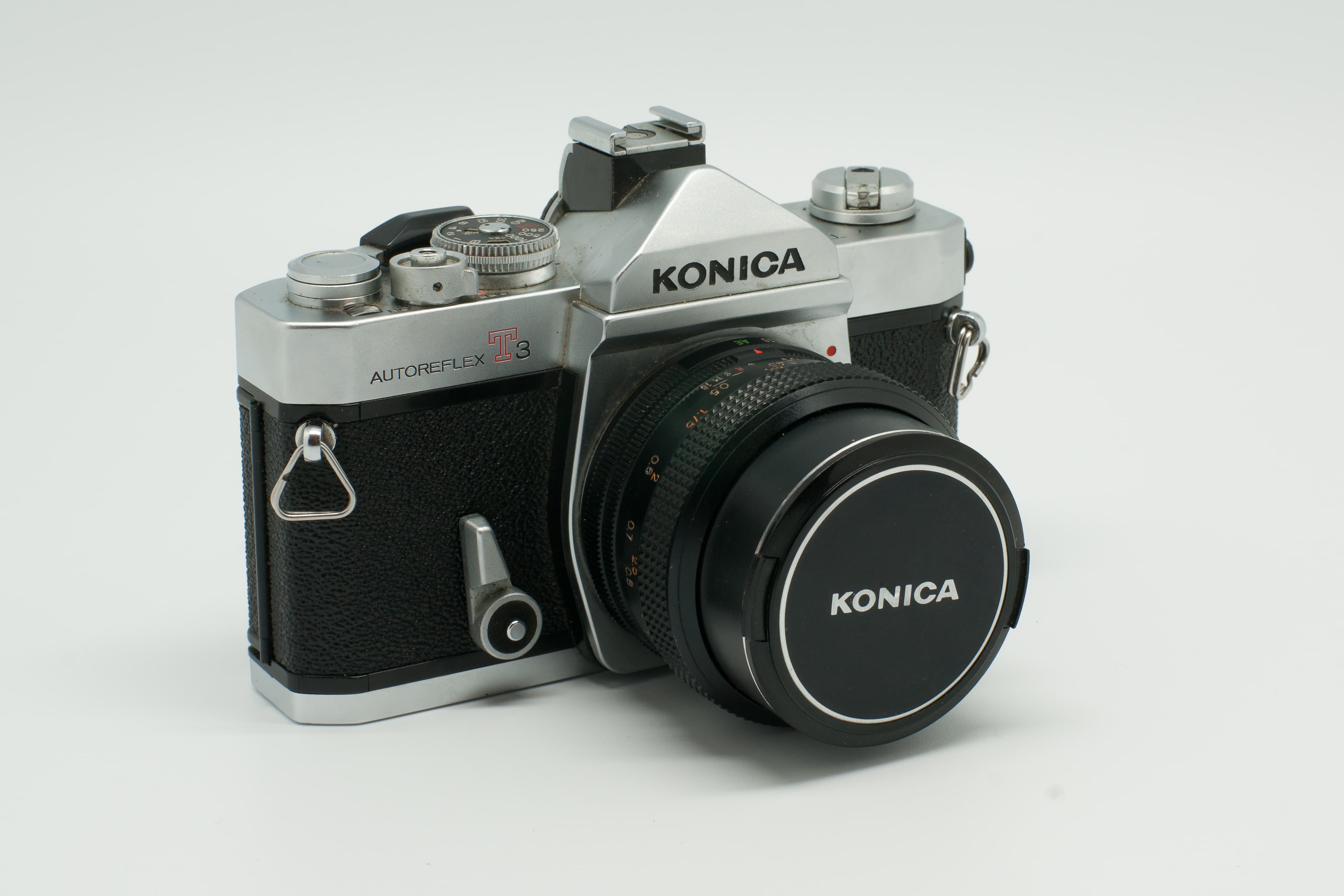
The Konica T3 (marketed as the Autoreflex T3 in some markets, 1973) is the third-generation Konica AR-mount SLR and the most mechanically accomplished body in the shutter-priority Autoreflex line. The T3 replaces the cloth horizontal shutter of the T and T2 with a vertical-travel metal focal-plane shutter - a meaningful engineering step that brought the Konica in line with higher-tier contemporaries and added a genuine mechanical fallback: the shutter fires at 1/1000s without battery, giving the T3 a reliability characteristic absent in its predecessors.
Reference
Recommended film stocks for the 35mm format your camera takes.
C41
Kodak Portra 400 is a professional C-41 color negative film known for flexible exposure latitude, natural skin tones, and fine grain.
View profileBW
Kodak Tri-X 400 is a classic black-and-white film known for strong tonality, visible grain, and documentary character.
View profileC41
Kodak Gold 200 is a daylight-balanced C-41 color negative film with warm color, moderate grain, and a classic consumer-film look.
Develop 35mm film
Labs in our directory that process 35mm film.
Before you buy used
About this camera
The definitive Konica shutter-priority SLR - vertical metal shutter, mechanical fallback, 800g build.
| Field | Value |
|---|
| Format | 35mm |
| Mount | Konica AR (bayonet) |
| Years | 1973-1976 |
| Shutter | 1s - 1/1000s + B, mechanical vertical metal |
| Flash sync | 1/125s |
| Meter | TTL CdS center-weighted |
| Modes | Shutter-priority AE, manual |
| ISO range | 25-1600 |
| Weight | 800 g |
| Dimensions | ~146 x 95 x 53 mm |
| Battery | 1x PX625 mercury (meter only) |
| Mechanical fallback | Yes - 1/1000s without battery |
| Viewfinder coverage | ~0.93 |
The T-series began with the Autoreflex T (1968), Konica's second AR-mount SLR and one of the earliest Japanese SLRs with practical TTL shutter-priority autoexposure. The T2 (~1972) refined the finder and improved flash sync but retained the cloth shutter. The T3 (1973) was the significant mechanical revision: the switch to a vertical metal shutter addressed the cloth curtain's longevity concerns and enabled the mechanical-fallback capability.
The T3 was produced for three years. In 1976 Konica introduced the TC, a lighter and less expensive body aimed at the amateur market growing rapidly through the decade. The T4 covered a premium niche. The T3 remained the benchmark of the shutter-priority Konica line in retrospective assessment - the body that balanced build quality, feature set, and Hexanon glass access most convincingly. The FS-1 (1979) subsequently moved Konica to motor-drive integration and aperture-priority metering, marking a change of operational philosophy.
A later variant, the T3N, was produced for certain export markets; differences are cosmetic.
The T3 is the reason Konica AR glass commands collector interest today. The combination of a reliable vertical metal shutter, full mechanical fallback, shutter-priority AE, and access to the entire Hexanon AR prime lens line made it a credible professional and serious-amateur tool in the mid-1970s Japanese and export markets. It competed directly against the Nikkormat FT2 and the Canon FTb, offering comparable metering with the less common shutter-priority orientation.
For contemporary photographers and collectors, the T3's mechanical fallback distinguishes it clearly from the T and T2: a dead battery leaves the T3 usable at 1/1000s, a practical rather than merely nominal difference for film shooters who run bodies hard. The 800g mass is higher than most modern preferences but signals a body engineered for durability rather than portability.
The AR-mount Hexanon primes - particularly the 50/1.4, 57/1.2, and the later 40/1.8 pancake - are the primary draw for adapted use on mirrorless cameras. The T3 body itself is a practical platform for all of them.
Full Konica AR mount compatibility. All Hexanon AR lenses couple for shutter-priority AE:
AR lenses adapt to Sony E, Fuji X, and Micro Four Thirds with passive adapters. The T3's own AR mount is not practical for adapting foreign lenses due to register distance constraints.
C41
Fujifilm Superia X-TRA 400 (marketed as Superia 400 in some regions) is an ISO 400 C-41 consumer color negative film in 135 format, one of Fujifilm's most popular consumer films. It delivers warm, vibrant colors with moderate grain and remains in production in some markets.
View profileBW
Ilford HP5 Plus is a flexible ISO 400 black-and-white film with classic grain and strong push-processing tolerance.
View profileC41
Kodak Ektar 100 is a fine-grain C-41 color negative film with saturated color and high sharpness.
View profile