C41
Kodak Portra 400
Kodak Portra 400 is a professional C-41 color negative film known for flexible exposure latitude, natural skin tones, and fine grain.
View profile35mm SLR
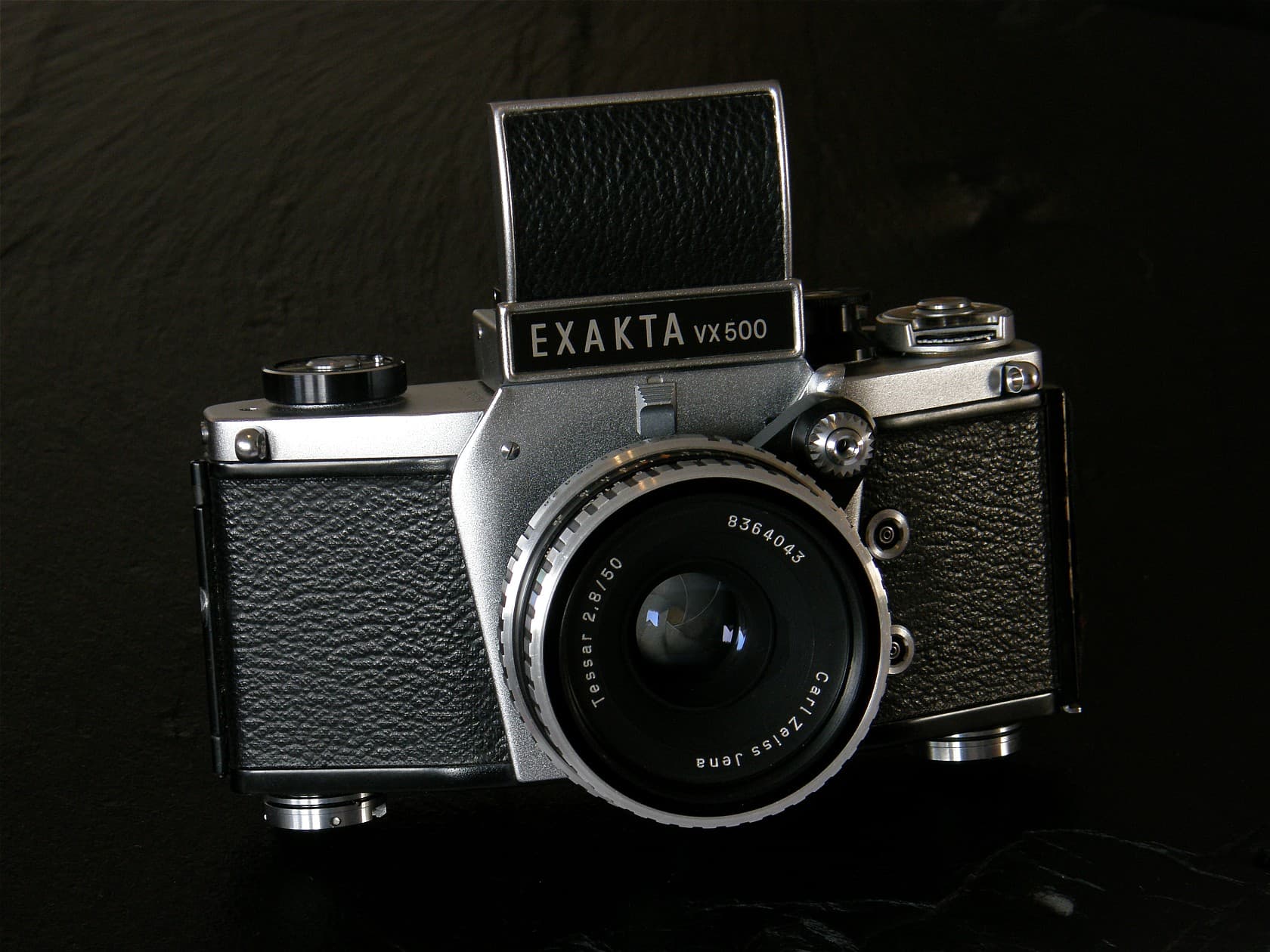
The Ihagee Exakta VX (1951) is a 35mm single-lens reflex camera made by Ihagee Kamerawerk in Dresden, East Germany. It is one of the most important cameras in SLR history — the culmination of Ihagee's pre-war Exakta design philosophy into a polished, professional postwar body that influenced SLR development worldwide.
Reference
Recommended film stocks for the 35mm format your camera takes.
C41
Kodak Portra 400 is a professional C-41 color negative film known for flexible exposure latitude, natural skin tones, and fine grain.
View profileBW
Kodak Tri-X 400 is a classic black-and-white film known for strong tonality, visible grain, and documentary character.
View profileC41
Kodak Gold 200 is a daylight-balanced C-41 color negative film with warm color, moderate grain, and a classic consumer-film look.
Develop 35mm film
Labs in our directory that process 35mm film.
Before you buy used
About this camera
The camera in James Stewart's hands in Rear Window — the Exakta VX was the definitive postwar iteration of Ihagee's left-handed SLR, offering a remarkable 12-second to 1/1000s shutter range and an interchangeable viewfinder system that set the standard for professional SLR design.
| Field | Value |
|---|
| Format | 35mm (24×36 mm) |
| Mount | Exakta bayonet (left-hand) |
| Years | 1951–1956 |
| Shutter | Cloth focal-plane: 12s – 1/1000s + B |
| Flash sync | X-sync 1/50s; FP and bulb sync available |
| Meter | None (external shoe accessory) |
| Exposure | Manual |
| Viewfinder | Interchangeable: pentaprism or waist-level |
| Focus | Manual, ground glass with magnifier |
| Battery | None |
Ihagee (Industrie- und Handels-Gesellschaft) was founded in Dresden in 1912 by the Dutch entrepreneur Johan Steenbergen. The original Exakta series began with the Vest Pocket Exakta in 1933 (a 127-film SLR) and the Kine-Exakta in 1936 (the first 35mm SLR with a focal-plane shutter). These prewar cameras established the Exakta name as synonymous with precision SLR photography.
After World War II and the partition of Germany, Ihagee continued operating in Dresden under East German state supervision, though Steenbergen had fled to West Germany. The postwar Exakta line resumed with the Exakta V (1950) and then the fully refined VX (1951). By this point, the Exakta was the SLR of choice for scientific, medical, and serious amateur photography worldwide — its interchangeable viewfinders, extreme shutter range, and extensive lens ecosystem made it uniquely capable.
Alfred Hitchcock's 1954 film Rear Window featured James Stewart prominently using an Exakta VX throughout — a piece of product placement that embedded the camera in popular culture and significantly boosted its recognition among non-photographers. The specific body used in the film was fitted with a large telephoto lens and is one of cinema's most famous camera appearances.
By the mid-1950s, the Nikon F and Leica R systems were beginning to challenge the Exakta's dominance among professionals, but the VX retained a loyal following particularly in scientific and macro photography applications. The Varex IIa and IIb continued production until 1970.
The Exakta VX matters for several interconnected reasons: it was the world's most sophisticated SLR at its launch, offering features (interchangeable finders, 12-second slow speeds, extensive lens range) that competitors would not match for years. Its left-hand layout, while unconventional, was ergonomically logical for certain shooting styles. The Exakta mount's lens ecosystem — particularly the Zeiss Jena Flektogon 35/2.4 and the Meyer-Optik Biotar 58/2 — remains sought after by photographers today for their rendering character. And the Rear Window appearance ensures the Exakta VX a permanent place in photographic cultural history.
Exakta bayonet mount. Core lenses: Carl Zeiss Jena Tessar 50/2.8, Biotar 58/2 (the classic portrait lens), Flektogon 35/2.4 and 25/4, Sonnar 135/3.5, Fernobjektiv 300/4.5. Meyer-Optik: Primotar 50/3.5, Oreston 50/1.8, Telemegor 180/5.5. Schneider: Curtagon 35/2.8, Xenon 50/1.9. Accessories: interchangeable pentaprism and waist-level finders, bellows unit, slide copying adapter, Exakta microscope adapter, cable release, Novoflex pistol grip.
C41
Fujifilm Superia X-TRA 400 (marketed as Superia 400 in some regions) is an ISO 400 C-41 consumer color negative film in 135 format, one of Fujifilm's most popular consumer films. It delivers warm, vibrant colors with moderate grain and remains in production in some markets.
View profileBW
Ilford HP5 Plus is a flexible ISO 400 black-and-white film with classic grain and strong push-processing tolerance.
View profileC41
Kodak Ektar 100 is a fine-grain C-41 color negative film with saturated color and high sharpness.
View profile