C41
Kodak Portra 400
Kodak Portra 400 is a professional C-41 color negative film known for flexible exposure latitude, natural skin tones, and fine grain.
View profile35mm SLR
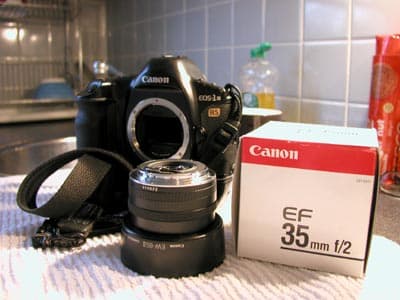
The Canon EOS-1N RS (1995) is a specialist sports/wildlife body. It uses a **fixed pellicle mirror** (semi-transparent, doesn't move) — about two-thirds of the light reaches the film, one-third reaches the viewfinder permanently. Result: **no viewfinder blackout** during continuous shooting at 10 fps. You can track action through the entire burst rather than losing sight of the subject between frames. The trade-off is half a stop of light loss in the viewfinder and exposure path.
Reference
Recommended film stocks for the 35mm format your camera takes.
C41
Kodak Portra 400 is a professional C-41 color negative film known for flexible exposure latitude, natural skin tones, and fine grain.
View profileBW
Kodak Tri-X 400 is a classic black-and-white film known for strong tonality, visible grain, and documentary character.
View profileC41
Kodak Gold 200 is a daylight-balanced C-41 color negative film with warm color, moderate grain, and a classic consumer-film look.
Develop 35mm film
Labs in our directory that process 35mm film.
Before you buy used
About this camera
The pellicle-mirror EOS-1N. 10 fps with no viewfinder blackout — the camera that sees what the film sees.
| Field | Value |
|---|
| Format | 35mm |
| Mount | Canon EF |
| Years | 1995–2000 |
| Shutter | 30s – 1/8000s + Bulb, electronic vertical cloth |
| Flash sync | 1/250s |
| Meter | TTL 16-zone evaluative SPD |
| AF | 5-point Multi-BASIS |
| Frame rate | 10 fps with built-in PB-E2 grip |
| Mirror | Fixed pellicle (no mirror lockup, no blackout) |
| Weight | 1,170 g (with integrated grip) |
| Battery | NP-E2 NiMH integrated |
Released 1995 as an EOS-1N variant for sports and wildlife photographers. The pellicle-mirror concept dates to the Canon Pellix (1965); Canon revived it for the RS to deliver 10 fps without the mirror-up time penalty. Production ran 5 years until 2000. Total volume was very low — perhaps a few thousand units — making the RS one of the rarest pro Canon film bodies.
The EOS-1N RS is the camera that sees what the film sees. For tracking fast-moving subjects (cycling, motorsport, birds), the no-blackout viewfinder is genuinely useful. The pellicle mirror also means there's no mirror slap, so vibration is reduced — useful for telephoto work on tripods.
For 2026 buyers, used RS prices run $600–1,200. The body itself is heavy (1.17 kg with integrated grip) but capable. Trade-off: the pellicle mirror collects dust, can't be cleaned without specialist tools, and the half-stop light loss complicates exposure in dim light.
Full Canon EF lens system, especially L-series sports/wildlife glass: 70-200/2.8L, 300/2.8L IS, 400/2.8L IS, 500/4L IS, 600/4L IS. The PB-E2 grip is integrated, not removable. Speedlite 540EZ / 580EX-II flashes for ETTL.
C41
Fujifilm Superia X-TRA 400 (marketed as Superia 400 in some regions) is an ISO 400 C-41 consumer color negative film in 135 format, one of Fujifilm's most popular consumer films. It delivers warm, vibrant colors with moderate grain and remains in production in some markets.
View profileBW
Ilford HP5 Plus is a flexible ISO 400 black-and-white film with classic grain and strong push-processing tolerance.
View profileC41
Kodak Ektar 100 is a fine-grain C-41 color negative film with saturated color and high sharpness.
View profile