C41
Kodak Portra 400
Kodak Portra 400 is a professional C-41 color negative film known for flexible exposure latitude, natural skin tones, and fine grain.
View profileMedium Format Rangefinder
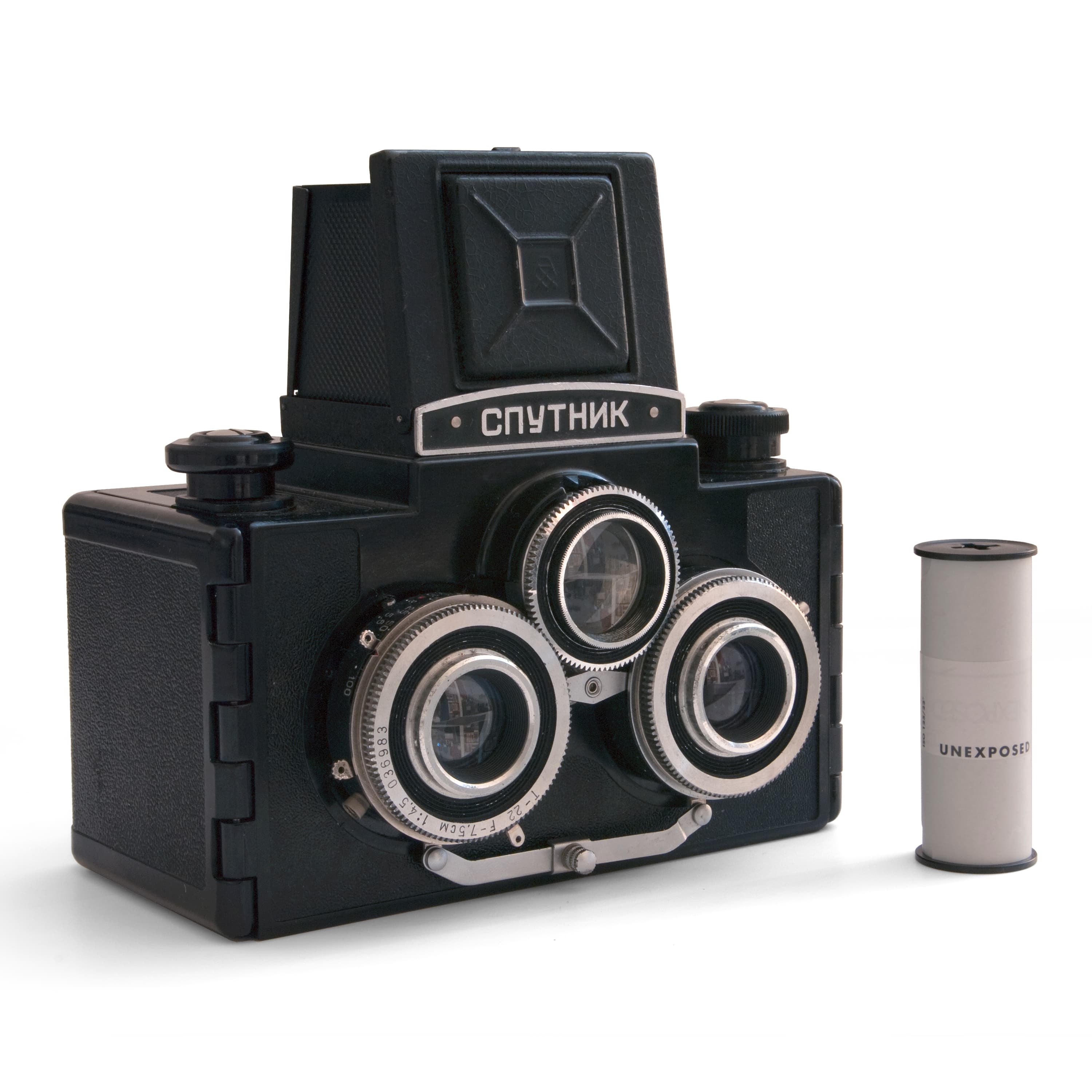
The Sputnik is a Soviet medium-format stereo camera produced by GOMZ (later reorganized as LOMO) in Leningrad, introduced in 1955. It exposes pairs of 6x6 cm frames on 120 roll film, with the two taking lenses spaced at the stereo baseline and a third lens above serving the reflex viewing system - making it a true TLR-style stereo camera. All three lenses are coupled: focusing the viewing lens simultaneously adjusts both taking lenses. A single central leaf shutter fires both taking lens paths at once. The Sputnik has no built-in light meter and uses zone focus rather than a coupled rangefinder. It was manufactured across several decades with minor detail revisions and remains the most commonly encountered Soviet medium-format stereo camera.
Reference
Recommended film stocks for the — format your camera takes.
C41
Kodak Portra 400 is a professional C-41 color negative film known for flexible exposure latitude, natural skin tones, and fine grain.
View profileC41
Kodak Portra 160 is a professional C-41 color negative film with fine grain, soft contrast, and natural color.
View profileC41
Kodak Ektar 100 is a fine-grain C-41 color negative film with saturated color and high sharpness.
Develop — film
We're growing the lab directory near you. Browse all labs.
Before you buy used
About this camera
Soviet three-lens 6x6 stereo TLR on 120 film - built in Leningrad from 1955.
| Field | Value |
|---|
| Format | 120 roll film |
| Frame size | 6x6 cm stereo pairs |
| Years | ~1955 - ~1991 |
| Lenses | Three - two taking (stereo pair) + one viewing TLR |
| Lens focal length | ~45mm (taking) |
| Lens aperture | ~f/4.5 |
| Shutter | Central leaf, ~1/10s - 1/125s + B |
| Meter | None |
| Focus | Zone focus |
| Viewfinder | Optical brightline (stereo) |
| Battery | None required |
The Sputnik appeared in 1955, two years before the Soviet satellite of the same name launched in October 1957; the camera's naming predates the space program association that now colors how collectors encounter the brand. GOMZ, the Leningrad Optical and Mechanical Association, had been producing cameras since the 1930s and was reorganized under the LOMO name in 1962. The Sputnik continued in production after the LOMO reorganization and saw periodic small revisions to lens coatings and body details without fundamental design changes. Production spanned several decades, making surviving examples more common than the shorter-run Druzhba. The camera filled a narrow niche: Soviet stereo photographers working in medium format rather than 35mm.
The Sputnik is significant as the primary Soviet entry in medium-format stereo photography. Soviet 35mm stereo cameras exist but are uncommon; a medium-format stereo TLR is a genuinely unusual configuration globally, not just within Soviet manufacture. The TLR viewing system with the third lens allows ground-glass composition, which 35mm stereo cameras typically lack. For working stereo photographers, the 6x6 frame size yields substantially more detail than 35mm stereo pairs, and the square format simplifies the geometry of stereo mounting and viewing. The long production run means examples in working condition are findable at accessible price points compared to the scarcer Druzhba. The camera sits at the intersection of Soviet-era manufacture, stereo photography, and medium format - a combination with dedicated collector interest.
E6
Fujifilm Fujichrome Provia 100F (RDPIII) is a professional E6 reversal (slide) film in 135 and 120 formats, known for its natural, balanced color reproduction, very fine grain, and moderate saturation. It remains in production as of 2026 and is one of the last professional slide films available.
View profileBW
Kodak Tri-X 400 is a classic black-and-white film known for strong tonality, visible grain, and documentary character.
View profile