C41
Kodak Portra 400
Kodak Portra 400 is a professional C-41 color negative film known for flexible exposure latitude, natural skin tones, and fine grain.
View profile35mm Rangefinder
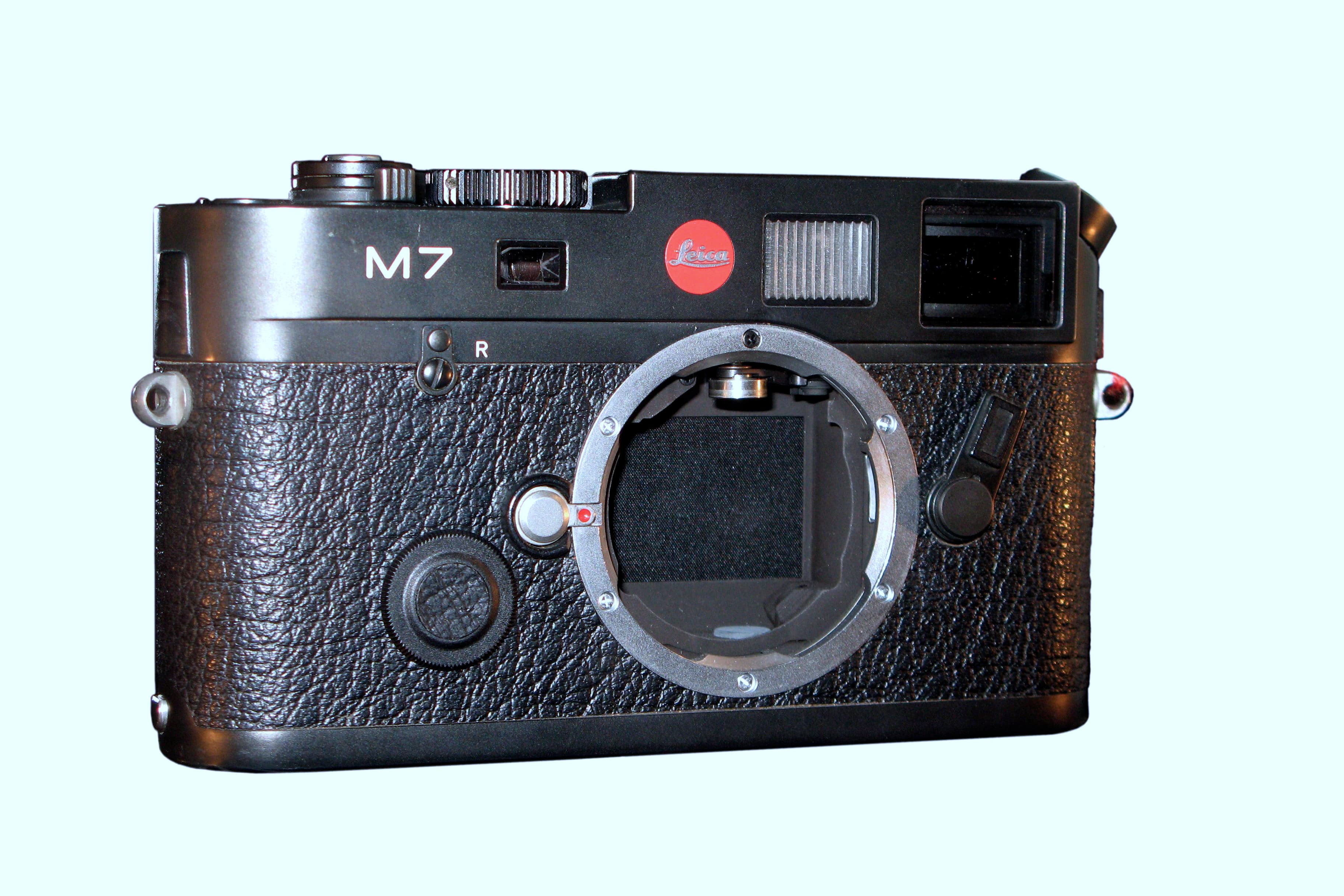
The M7 (2002) was Leica's response to a long-running customer ask: aperture-priority autoexposure on the M body. The camera uses an electronic horizontal-cloth shutter timed by a quartz oscillator (so AE exposures are stepless instead of stop-clicked), keeps the M6's TTL meter, and adds **DX coding** so the camera reads ISO from the cassette automatically. Two mechanical fallback speeds (1/60s and 1/125s) allow the camera to fire if the battery dies.
Reference
Recommended film stocks for the 35mm format your camera takes.
C41
Kodak Portra 400 is a professional C-41 color negative film known for flexible exposure latitude, natural skin tones, and fine grain.
View profileBW
Ilford HP5 Plus is a flexible ISO 400 black-and-white film with classic grain and strong push-processing tolerance.
View profileBW
Kodak Tri-X 400 is a classic black-and-white film known for strong tonality, visible grain, and documentary character.
Develop 35mm film
Labs in our directory that process 35mm film.
Before you buy used
About this camera
The first electronic-shutter Leica M. Aperture priority on a rangefinder, finally.
| Field | Value |
|---|
| Format | 35mm |
| Mount | Leica M |
| Years | 2002–2018 |
| Shutter | 32s – 1/1000s (later 1/4000s), electronic horizontal cloth |
| Flash sync | 1/50s |
| Meter | TTL center-weighted silicon |
| Modes | Aperture priority, manual |
| Mechanical fallback | 1/60s, 1/125s |
| Weight | 610 g |
| Battery | 2× SR44 / DL1/3N |
Released 2002 alongside the all-mechanical MP — Leica's pair-release strategy: M7 for photographers who wanted automation, MP for those who wanted pure mechanical. Production ran 16 years until 2018. A 0.58× / 0.72× / 0.85× finder magnification choice was offered. The "Hermès Edition" and other limited runs (à-la-carte program) appeared throughout the production run.
The M7 made working photographers' lives easier. Aperture priority on a rangefinder means you can shoot in changing light without recalculating shutter speed every time. The DX coding feature meant no more dialing in ISO when swapping films. The flash TTL system was useful for fill-flash work in editorial portraiture.
In Leica orthodoxy, the M7 occupies an awkward middle ground: it's not a "pure" mechanical M (purists prefer MP/M-A) and not a digital M. It was the most-bought new Leica film camera of the 2000s, partly because the MP was overshadowed and the M6 was already discontinued.
All M-mount lenses, all eras. SF20 / SF24D flashes for TTL fill. Motor-M / Winder-M (the latter rare). À-la-carte body custom orders permitted nearly any cosmetic specification including special engraving.
BW
Fujifilm Neopan 100 Acros is an ultra-fine-grain ISO 100 black-and-white negative film celebrated for its world-class granularity, wide tonal range, and exceptional reciprocity characteristics. The original Acros was discontinued in 2018; Acros II relaunched in November 2019 with a reformulated emulsion and is the current production version.
View profileC41
Kodak Portra 160 is a professional C-41 color negative film with fine grain, soft contrast, and natural color.
View profileC41
Kodak Gold 200 is a daylight-balanced C-41 color negative film with warm color, moderate grain, and a classic consumer-film look.
View profile