C41
Kodak Portra 400
Kodak Portra 400 is a professional C-41 color negative film known for flexible exposure latitude, natural skin tones, and fine grain.
View profile35mm Rangefinder
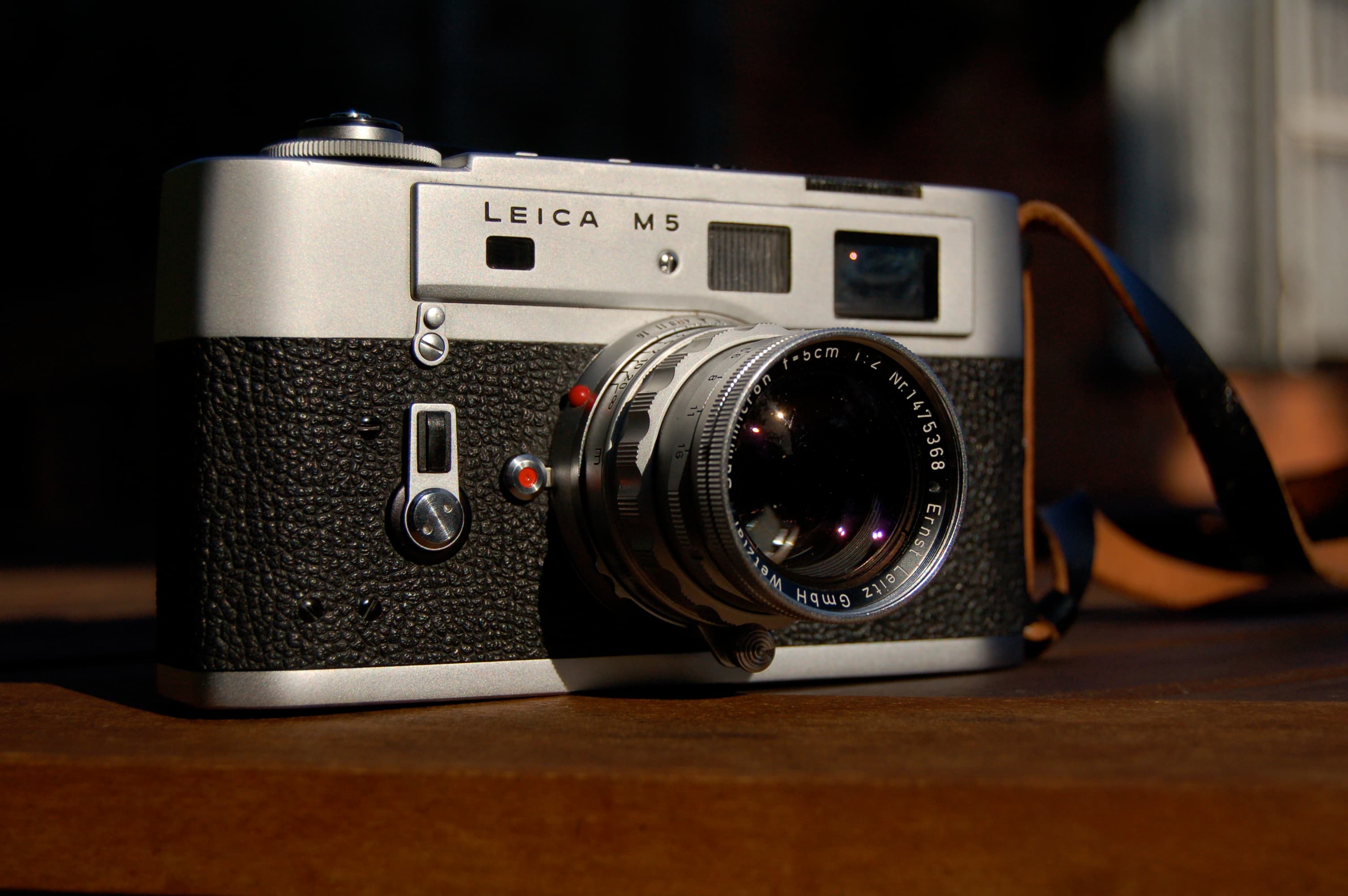
The Leica M5 (1971) was Leica's first M-system body with built-in TTL metering. The meter cell sits on a **swing arm** that moves into the light path during exposure measurement and retracts when you fire — a mechanically clever solution to TTL on a rangefinder body. Same mechanical horizontal-cloth shutter as the M4, same M-mount, but a noticeably larger body — 150 mm wide (vs M4's 138 mm), heavier, and with a redesigned shutter dial that's larger and easier to thumb without leaving the eyepiece.
Reference
Recommended film stocks for the 35mm format your camera takes.
C41
Kodak Portra 400 is a professional C-41 color negative film known for flexible exposure latitude, natural skin tones, and fine grain.
View profileBW
Ilford HP5 Plus is a flexible ISO 400 black-and-white film with classic grain and strong push-processing tolerance.
View profileBW
Kodak Tri-X 400 is a classic black-and-white film known for strong tonality, visible grain, and documentary character.
Develop 35mm film
Labs in our directory that process 35mm film.
Before you buy used
About this camera
Leica's first M with a TTL meter. Wider, taller, heavier than the M4 — controversial in 1971, fascinating in 2026.
| Field | Value |
|---|
| Format | 35mm |
| Mount | Leica M |
| Years | 1971–1975 |
| Shutter | 1/2s – 1/1000s + B, mechanical horizontal cloth |
| Flash sync | 1/50s |
| Meter | TTL CdS spot via swing-arm |
| Modes | Manual |
| Frame lines | 35, 50, 90, 135 mm |
| Weight | 700 g |
| Battery | 1× PX625 mercury (meter only) |
Released 1971. Sales were poor — Leica purists rejected the larger body, and the meter mechanism was seen as a complication. Only 33,900 M5 bodies were made before Leica discontinued it in 1975 — by far the lowest production number of any "modern" Leica M. Leica responded by reverting to the M4 form factor with the M4-2 (Canada-built, 1977) and M4-P (1981), neither of which had a meter. The next M with a meter would be the M6 (1984), which used silicon cells and returned to the M4-size body.
The M5 is Leica's commercial failure that's now beloved. For working photographers, it's actually one of the best mechanical Leica Ms ever made — the larger body is more ergonomic for big hands, the shutter dial is easier to operate with the camera at the eye, and the swing-arm meter is genuinely useful. It just looked wrong to 1971 customers who wanted M3/M4 silhouettes.
For 2026 buyers, used M5 prices are lower than equivalent M6 bodies despite mechanical excellence — partly because of stigma, partly because the mercury-battery meter is a hassle. A clean M5 at $1,500–3,000 is one of the more interesting Leica M values, especially for photographers willing to deal with PX625 voltage adapters.
All Leica M-mount lenses, all eras. The swing-arm meter caps at lens dimensions: lenses with deep rear elements (some collapsibles, the 21mm Super-Angulon) physically cannot fit because the swing arm sits in the light path before the focal-plane shutter. Most modern M lenses are fine.
BW
Fujifilm Neopan 100 Acros is an ultra-fine-grain ISO 100 black-and-white negative film celebrated for its world-class granularity, wide tonal range, and exceptional reciprocity characteristics. The original Acros was discontinued in 2018; Acros II relaunched in November 2019 with a reformulated emulsion and is the current production version.
View profileC41
Kodak Portra 160 is a professional C-41 color negative film with fine grain, soft contrast, and natural color.
View profileC41
Kodak Gold 200 is a daylight-balanced C-41 color negative film with warm color, moderate grain, and a classic consumer-film look.
View profile