C41
Kodak Portra 400
Kodak Portra 400 is a professional C-41 color negative film known for flexible exposure latitude, natural skin tones, and fine grain.
View profile35mm Rangefinder
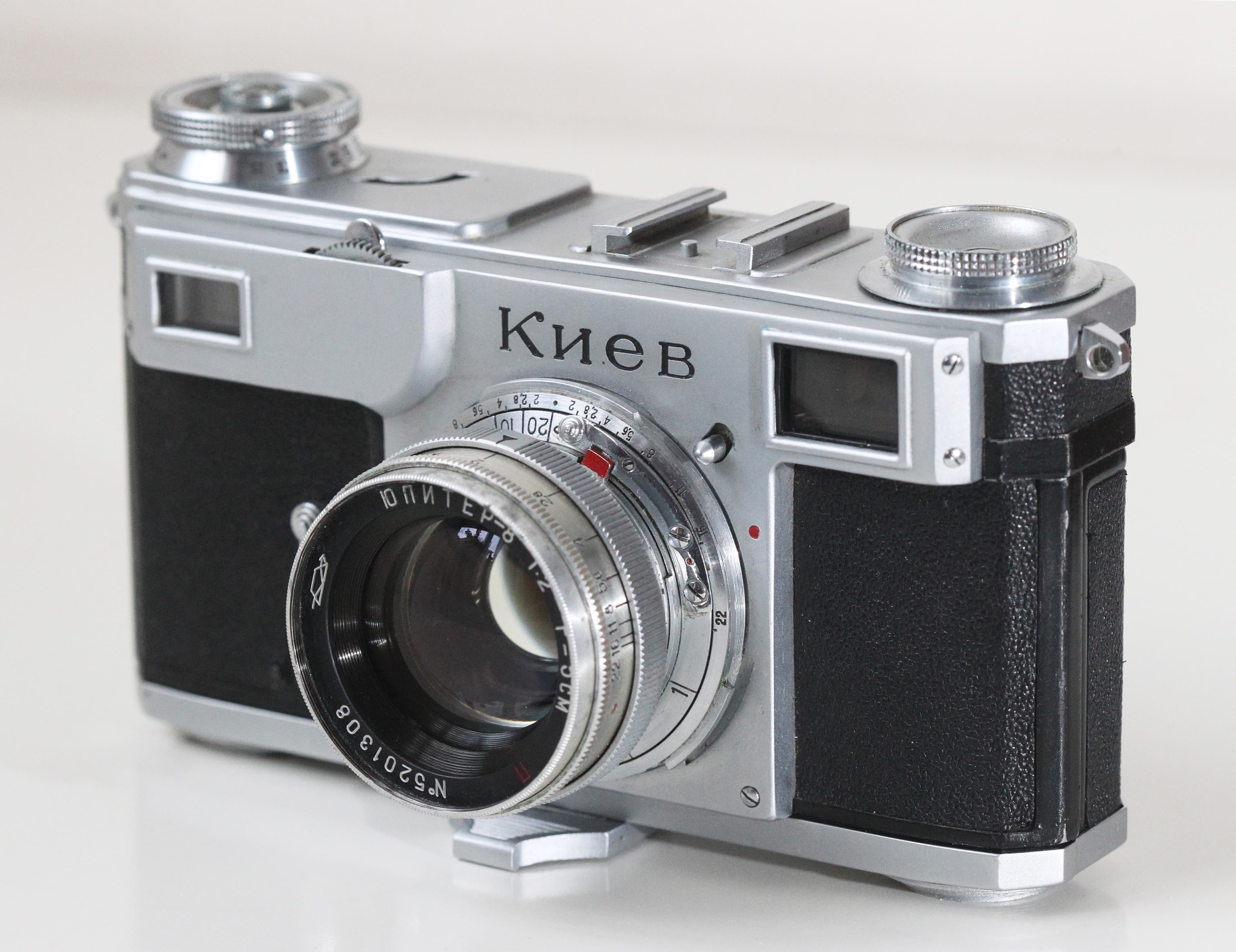
The Kiev 2 (1947) is the first camera produced by the Arsenal factory in Kiev, Ukraine, built using Zeiss Ikon Contax II tooling and drawings taken as war reparations after Germany's defeat. It is essentially a re-branded Contax II — same vertically-traveling metal-curtain shutter (unique at the time; Leica used horizontal cloth), same 90 mm rangefinder baseline, same Contax bayonet mount. Soviet engineers initially produced bodies nearly identical to the Contax II; over successive generations (Kiev 3, Kiev 4) the design was refined, but the Kiev 2 is the purest Contax clone.
Reference
Recommended film stocks for the 35mm format your camera takes.
C41
Kodak Portra 400 is a professional C-41 color negative film known for flexible exposure latitude, natural skin tones, and fine grain.
View profileBW
Ilford HP5 Plus is a flexible ISO 400 black-and-white film with classic grain and strong push-processing tolerance.
View profileBW
Kodak Tri-X 400 is a classic black-and-white film known for strong tonality, visible grain, and documentary character.
Develop 35mm film
Labs in our directory that process 35mm film.
Before you buy used
About this camera
The original Soviet Contax II clone. Born from captured Zeiss tooling shipped to Ukraine as WWII reparations, the Kiev 2 started one of the longest-running Soviet camera lineages.
| Field | Value |
|---|
| Format | 35mm |
| Mount | Contax/Kiev (Contax rangefinder bayonet) |
| Years | 1947–1955 |
| Shutter | 1/2s – 1/1250s + B, mechanical vertical metal curtain |
| Flash sync | None |
| Meter | None |
| Modes | Manual |
| Weight | ~820 g |
| Battery | None |
After WWII, the Soviet Union dismantled the Carl Zeiss Jena and Zeiss Ikon factories in Jena and Dresden and shipped machinery, tooling, and (reportedly) key engineers east. The Arsenal plant in Kiev received the Contax II production line. The first cameras rolled off the line in 1947 under the name Kiev. Early bodies carry a Contax-style finish and even Zeiss-branded lenses on some pre-production or transitional examples. By the early 1950s, Soviet-made Jupiter lenses — Zeiss Sonnar optical designs produced under license — became standard. The Kiev 2 gave way to the Kiev 3 (1952, adding a selenium meter) and ultimately the Kiev 4 series (1957–1986).
The Kiev 2 represents the most direct link between the prewar German Contax II and the Soviet Kiev lineage. Collectors prize early examples for their near-Contax provenance. For shooters, the long 90 mm rangefinder baseline remains a technical advantage for precise focus, and the vertical metal shutter is more resistant to wear than cloth horizontals. The Contax/Kiev mount accepts high-quality Soviet Jupiter lenses at a fraction of Zeiss prices.
A Contax II in good working order costs $1,000–2,000+ today. A Kiev 2 with similar shooting characteristics runs $120–350, though Soviet quality control demands careful inspection before purchase.
Contax/Kiev bayonet mount: Jupiter-3 50/1.5 (Sonnar copy), Jupiter-8 50/2 (Sonnar copy), Jupiter-12 35/2.8 (Biogon copy), Jupiter-9 85/2 (Sonnar copy). Genuine Zeiss Contax II lenses (Sonnar 50/1.5, Sonnar 50/2, Biogon 35/2.8) also fit. Adapter rings allow using Leica-thread (LTM) lenses with some finder parallax.
BW
Fujifilm Neopan 100 Acros is an ultra-fine-grain ISO 100 black-and-white negative film celebrated for its world-class granularity, wide tonal range, and exceptional reciprocity characteristics. The original Acros was discontinued in 2018; Acros II relaunched in November 2019 with a reformulated emulsion and is the current production version.
View profileC41
Kodak Portra 160 is a professional C-41 color negative film with fine grain, soft contrast, and natural color.
View profileC41
Kodak Gold 200 is a daylight-balanced C-41 color negative film with warm color, moderate grain, and a classic consumer-film look.
View profile