C41
Kodak Portra 400
Kodak Portra 400 is a professional C-41 color negative film known for flexible exposure latitude, natural skin tones, and fine grain.
View profile35mm Rangefinder
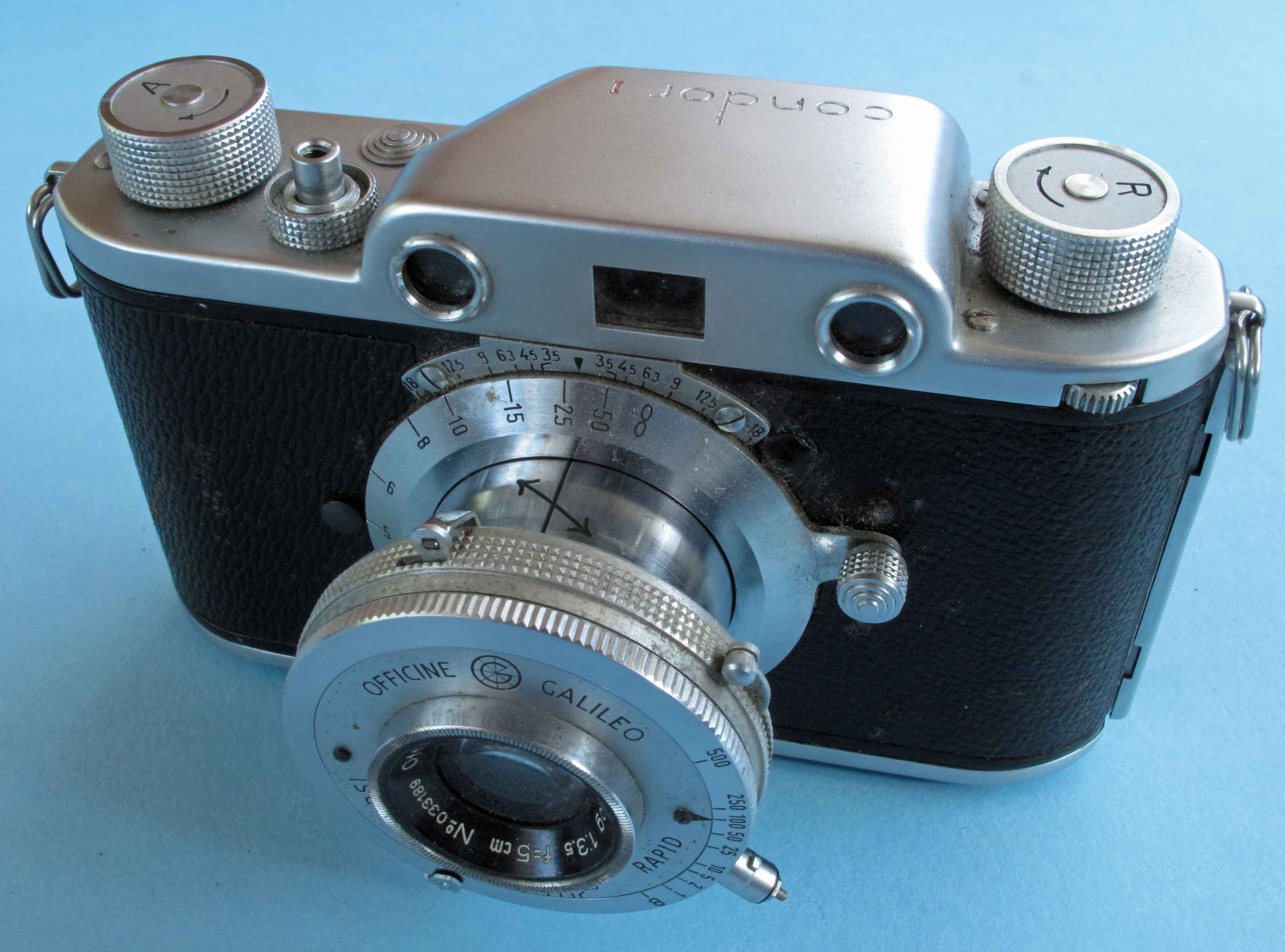
The Galileo Condor I is a 35mm coupled-rangefinder camera produced by Galileo Officine Italiane (OIM - Ottica e Meccanica Italiana, or Officine Italiane di Milano in some sources) around 1947. It represents one of the more serious Italian attempts to enter the precision 35mm camera market in the immediate postwar period, competing in concept if not in scale with the established German rangefinder tradition of Leica and Contax.
Reference
Recommended film stocks for the 35mm format your camera takes.
C41
Kodak Portra 400 is a professional C-41 color negative film known for flexible exposure latitude, natural skin tones, and fine grain.
View profileBW
Ilford HP5 Plus is a flexible ISO 400 black-and-white film with classic grain and strong push-processing tolerance.
View profileBW
Kodak Tri-X 400 is a classic black-and-white film known for strong tonality, visible grain, and documentary character.
Develop 35mm film
Labs in our directory that process 35mm film.
Before you buy used
About this camera
A handsome postwar Italian rangefinder from the Florentine optical firm Galileo, carrying an Eliog 50/3.5 and a coupled rangefinder.
| Field | Value |
|---|
| Format | 35mm |
| Mount | Fixed Eliog 50mm f/3.5 |
| Year | ~1947 |
| Shutter | Leaf, ~1s - 1/300s + B |
| Meter | None |
| Focus | Coupled rangefinder |
| Viewfinder | Combined RF/VF |
| Battery | None required |
Galileo Officine Italiane was a Florence-based precision optics manufacturer with roots in scientific and military instrument production. By the postwar period the firm had the optical expertise to produce camera lenses and attempted to leverage this into a consumer camera line. The Condor I was the first model in what appears to have been a brief series; the Condor II followed as a refinement, though both were produced in relatively small numbers.
Italian camera manufacturing in the late 1940s faced steep competition from recovered German industry and, increasingly, from Japanese manufacturers. The premium rangefinder segment that Galileo targeted was dominated by Leica, Contax, and the emerging Canon and Nikon lines from Japan. Italian manufacturers including Galileo, Ferrania, and Gamma lacked the distribution networks and volume economics to compete at scale, and most Italian precision camera ventures of this era were short-lived.
The Condor I's place in production history is not well documented in English-language sources, and the exact years of manufacture and total units produced remain unverified.
The Galileo Condor I is significant primarily as evidence of the breadth of European postwar photographic ambition. While Germany's camera industry rapidly recovered to dominate the 1950s precision camera market, Italy had the optical infrastructure - demonstrated by Galileo, Koristka, and Ducati - to have developed a parallel tradition. That it did not is as much a story of economics and distribution as of engineering capability.
The Eliog 50/3.5 is a modest performer by the standards of contemporaneous German glass, but it reflects genuine optical design effort. Working examples of the Condor I allow direct comparison with period German compacts at similar apertures, and the camera's coupled rangefinder gives it usability advantages over simpler Italian contemporaries.
For collectors, the Condor I occupies an interesting niche: Italian, postwar, optically indigenous, and rare enough to be genuinely hard to find, yet not so famous as to command extreme prices.
BW
Fujifilm Neopan 100 Acros is an ultra-fine-grain ISO 100 black-and-white negative film celebrated for its world-class granularity, wide tonal range, and exceptional reciprocity characteristics. The original Acros was discontinued in 2018; Acros II relaunched in November 2019 with a reformulated emulsion and is the current production version.
View profileC41
Kodak Portra 160 is a professional C-41 color negative film with fine grain, soft contrast, and natural color.
View profileC41
Kodak Gold 200 is a daylight-balanced C-41 color negative film with warm color, moderate grain, and a classic consumer-film look.
View profile