C41
Kodak Portra 400
Kodak Portra 400 is a professional C-41 color negative film known for flexible exposure latitude, natural skin tones, and fine grain.
View profile35mm Rangefinder
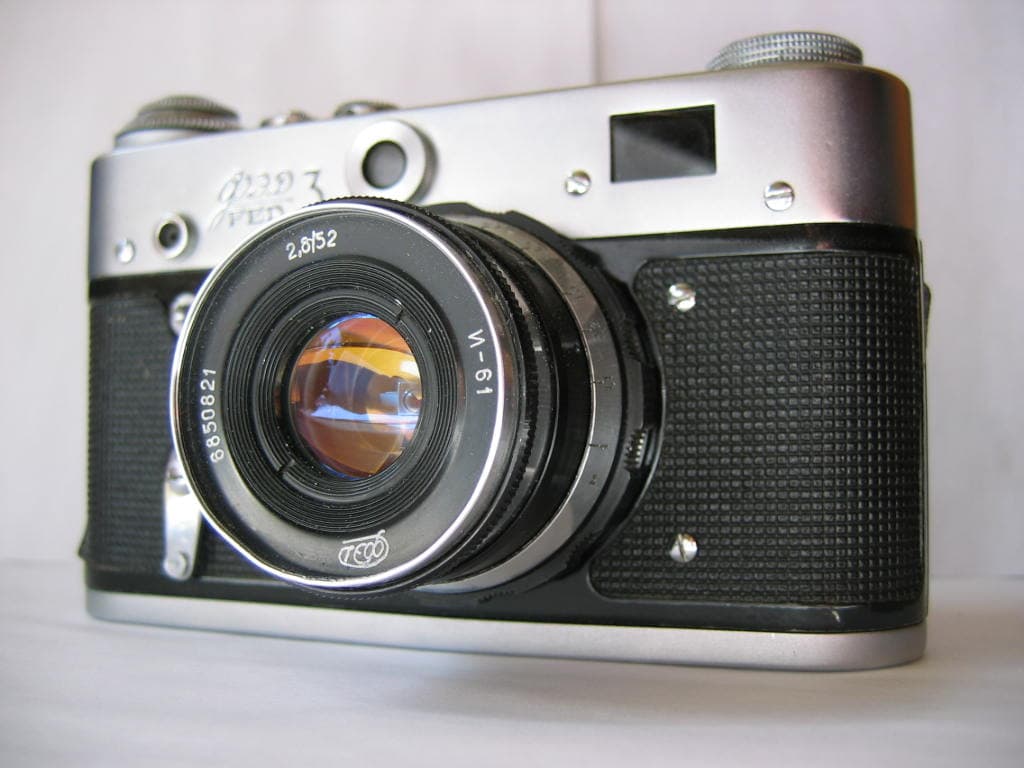
The FED-3B is a 35mm rangefinder camera produced by FED (the Feliks Edmundovich Dzerzhinsky factory) in Kharkov, Ukrainian SSR, introduced around 1968. It is a variant of the FED-3 distinguished primarily by its rapid lever film advance, replacing the knob-wind mechanism of the earlier FED-3 production. Like all FED cameras of this era, the 3B is a descendent of the Leica II/III design that Soviet engineers reverse-engineered in the 1930s. The camera uses the M39 Leica Thread Mount, providing compatibility with the extensive range of Soviet M39 lenses (Jupiter, Industar, Elmar copies) as well as genuine Leica screwmount glass with appropriate adapter use. The shutter is an all-mechanical horizontal cloth focal plane type, fully operable without battery - there is no built-in metering. The combined viewfinder and rangefinder are in a single window, a refinement over the separate windows on older Soviet Barnack-derived bodies.
Reference
Recommended film stocks for the 35mm format your camera takes.
C41
Kodak Portra 400 is a professional C-41 color negative film known for flexible exposure latitude, natural skin tones, and fine grain.
View profileBW
Ilford HP5 Plus is a flexible ISO 400 black-and-white film with classic grain and strong push-processing tolerance.
View profileBW
Kodak Tri-X 400 is a classic black-and-white film known for strong tonality, visible grain, and documentary character.
Develop 35mm film
Labs in our directory that process 35mm film.
Before you buy used
About this camera
The lever-advance variant of the FED-3 - a refined Soviet M39 rangefinder from Kharkov.
| Field | Value |
|---|
| Format | 35mm |
| Mount | M39 Leica Thread Mount |
| Years | ~1968 - ~1979 |
| Shutter | ~1/25s - 1/500s + B, horizontal cloth |
| Flash sync | ~1/25s (FP sync) |
| Meter | None |
| Modes | Manual |
| Weight | ~600 g |
| Battery | None required |
| Focus | Rangefinder patch |
FED cameras trace their origins to the Kharkov NKVD commune workshops where Soviet engineers began copying the Leica II in 1934. By the 1950s and 1960s, the FED factory had developed the Barnack-derived design through successive generations. The FED-3 entered production in the early 1960s as a modernized body with self-timer, PC flash sync, and combined viewfinder/rangefinder. The FED-3B variant introduced the lever advance - a significant usability improvement that aligned the camera with contemporary Japanese rangefinders of the period. The FED-4, introduced in the early 1960s, added a built-in selenium meter; the FED-3B represents the last of the purely mechanical, non-metered FED bodies in the main line before metering became standard. Production of the FED-3B continued through the late 1970s.
The FED-3B is significant as a fully mechanical M39 rangefinder that remains highly usable for film photography today. Without a meter, it avoids the aging-selenium and corroded-battery problems that affect metered Soviet cameras. The lever advance makes it more practical for continuous shooting than knob-wind predecessors. M39 compatibility gives access to a large and inexpensive pool of Soviet lenses - the Industar-61 55mm f/2.8 and Jupiter-8 50mm f/2 being the most common pairings. For photographers wanting an entry into Soviet rangefinder shooting without the complications of metered electronics, the FED-3B offers straightforward mechanical reliability at modest cost.
Mount: M39 Leica Thread Mount (39mm x 1mm pitch screw). Compatible with:
A clip-on external meter (such as the Sverdlovsk-4 selenium meter) was used by Soviet photographers in lieu of a built-in meter. Standard 135 35mm cassettes load via a removable base plate in the Barnack tradition.
BW
Fujifilm Neopan 100 Acros is an ultra-fine-grain ISO 100 black-and-white negative film celebrated for its world-class granularity, wide tonal range, and exceptional reciprocity characteristics. The original Acros was discontinued in 2018; Acros II relaunched in November 2019 with a reformulated emulsion and is the current production version.
View profileC41
Kodak Portra 160 is a professional C-41 color negative film with fine grain, soft contrast, and natural color.
View profileC41
Kodak Gold 200 is a daylight-balanced C-41 color negative film with warm color, moderate grain, and a classic consumer-film look.
View profile