C41
Kodak Portra 400
Kodak Portra 400 is a professional C-41 color negative film known for flexible exposure latitude, natural skin tones, and fine grain.
View profile35mm Rangefinder
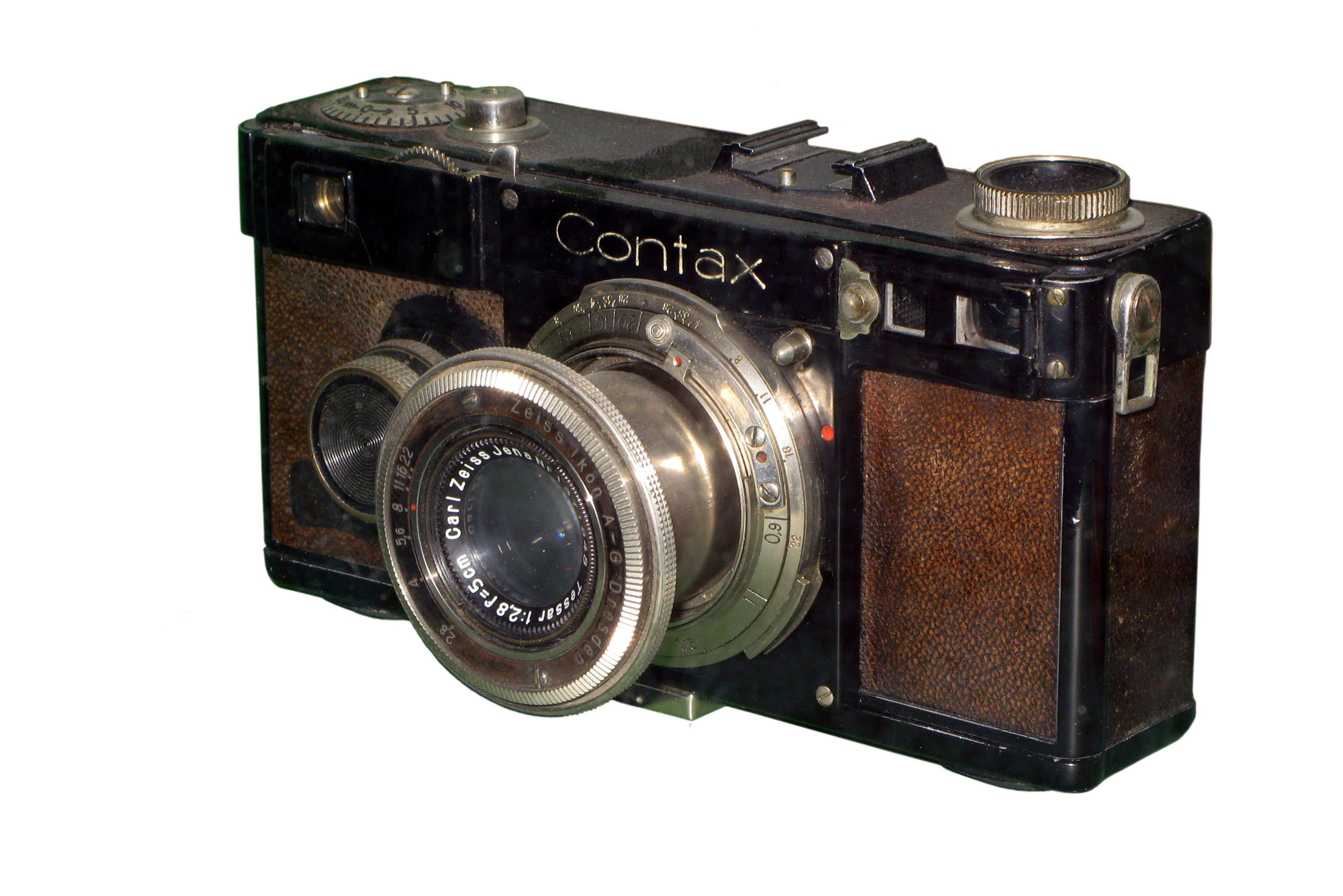
The Contax I (1932) is the original camera in the Contax rangefinder lineage, designed and manufactured by Zeiss Ikon in Dresden as a direct technological competitor to the Leica II. Where Oskar Barnack's Leica was compact and elegantly simple, the Contax I was ambitious: it introduced a longer rangefinder base length for more accurate focusing, a distinctive internal bayonet mount designed to accept Zeiss's finest optics with minimal optical compromises, and a cloth focal-plane shutter reaching 1/1000s.
Reference
Recommended film stocks for the 35mm format your camera takes.
C41
Kodak Portra 400 is a professional C-41 color negative film known for flexible exposure latitude, natural skin tones, and fine grain.
View profileBW
Ilford HP5 Plus is a flexible ISO 400 black-and-white film with classic grain and strong push-processing tolerance.
View profileBW
Kodak Tri-X 400 is a classic black-and-white film known for strong tonality, visible grain, and documentary character.
Develop 35mm film
Labs in our directory that process 35mm film.
Before you buy used
The Contax I is a collector's camera. Buying one for regular use is not advisable without significant research and realistic expectations:
Working examples in good cosmetic condition typically sell in the $200-800 range depending on variant, completeness, and shutter function. Collector-grade examples with clean glass command more.
About this camera
The founding Contax: Zeiss Ikon's 1932 answer to the Leica, establishing the rangefinder line that would bear the name for decades.
| Field | Value |
|---|
| Format | 35mm |
| Mount | Contax RF bayonet (internal) |
| Introduced | 1932 |
| Shutter | ~1s - 1/1000s + B, cloth vertical focal-plane |
| Flash sync | None (pre-flash sync era) |
| Meter | None |
| Modes | Manual only |
| Battery | None required |
| Mechanical fallback | Full (no electronics) |
Zeiss Ikon introduced the Contax I in 1932, three years after the commercial launch of the Leica II, and in direct response to the market Barnack's camera had created. The Zeiss engineering team, led by Hubert Nerwin, designed the Contax around different priorities: a longer rangefinder base for more precise focus at distance, a bayonet mount (rather than screwmount) for faster lens changes, and an unconventional vertical cloth shutter with metal guide rails rather than the Leica's horizontal curtain design.
The Contax I was produced in at least three or four variant forms across its production run from 1932 to approximately 1936, with each revision addressing practical shortcomings of the previous version - particularly the shutter and the rangefinder coupling mechanism, which were both prone to issues in early production.
The Contax II and III, launched in 1936, represented a near-complete mechanical redesign: faster top shutter speed, a combined viewfinder-rangefinder eyepiece, and substantially improved build quality. The Contax I was thereafter regarded as the earlier, rougher-edged founding model.
Production ceased with the disruption of World War II. Post-war, the East German VEB Carl Zeiss Jena continued a parallel lineage via the Kiev rangefinders (based on tooling taken to the Soviet Union), while the West German successor developed the Contax IIa and IIIa in Stuttgart.
The Contax I is significant not for being a great user camera - it is difficult to service, has pre-war optics whose condition is now entirely luck-of-the-draw, and was mechanically surpassed by its own successor four years later - but for being the founding artifact of a lineage that ran, in various forms, from 1932 through the Contax G2 (1998) and arguably to the Contax-branded digital collaborations of the early 2000s.
It represents Zeiss's assertion that optical quality and engineering ambition could rival Barnack's minimalism. The Contax mount's optical register allowed Zeiss to design lenses - particularly the Carl Zeiss Sonnar designs of the 1930s - that were among the finest available on any camera system of their time. The 50mm f/1.5 Sonnar made possible in 1932 by the Contax's bayonet register was a landmark lens of the era.
The camera also illustrates the pre-war German camera industry at its most competitive and innovative: a period when Dresden and Wetzlar were the world centers of precision optical manufacturing, before the war and subsequent division of Germany permanently disrupted that ecosystem.
The Contax I uses an internal bayonet mount with a relatively long flange distance, designed to accommodate the rear element of the early Sonnar designs deep inside the body. Lenses from the original Contax I era include:
Contax I lenses are not interchangeable with Contax II/IIa/III/IIIa lenses without adaptation in all cases, due to differences in the bayonet implementation across generations.
Modern use of Contax I lenses is specialist territory: adapters for contemporary mirrorless cameras exist but are uncommon and expensive.
The Contax I and its contemporary Zeiss Sonnar lenses were used by professional photographers throughout the 1930s, particularly in Germany and Europe, as a serious alternative to the Leica. Specific attribution to the Contax I (vs later Contax models) is difficult to verify in most photographic histories.
BW
Fujifilm Neopan 100 Acros is an ultra-fine-grain ISO 100 black-and-white negative film celebrated for its world-class granularity, wide tonal range, and exceptional reciprocity characteristics. The original Acros was discontinued in 2018; Acros II relaunched in November 2019 with a reformulated emulsion and is the current production version.
View profileC41
Kodak Portra 160 is a professional C-41 color negative film with fine grain, soft contrast, and natural color.
View profileC41
Kodak Gold 200 is a daylight-balanced C-41 color negative film with warm color, moderate grain, and a classic consumer-film look.
View profile