C41
Kodak Gold 200
Kodak Gold 200 is a daylight-balanced C-41 color negative film with warm color, moderate grain, and a classic consumer-film look.
View profileHalf-Frame
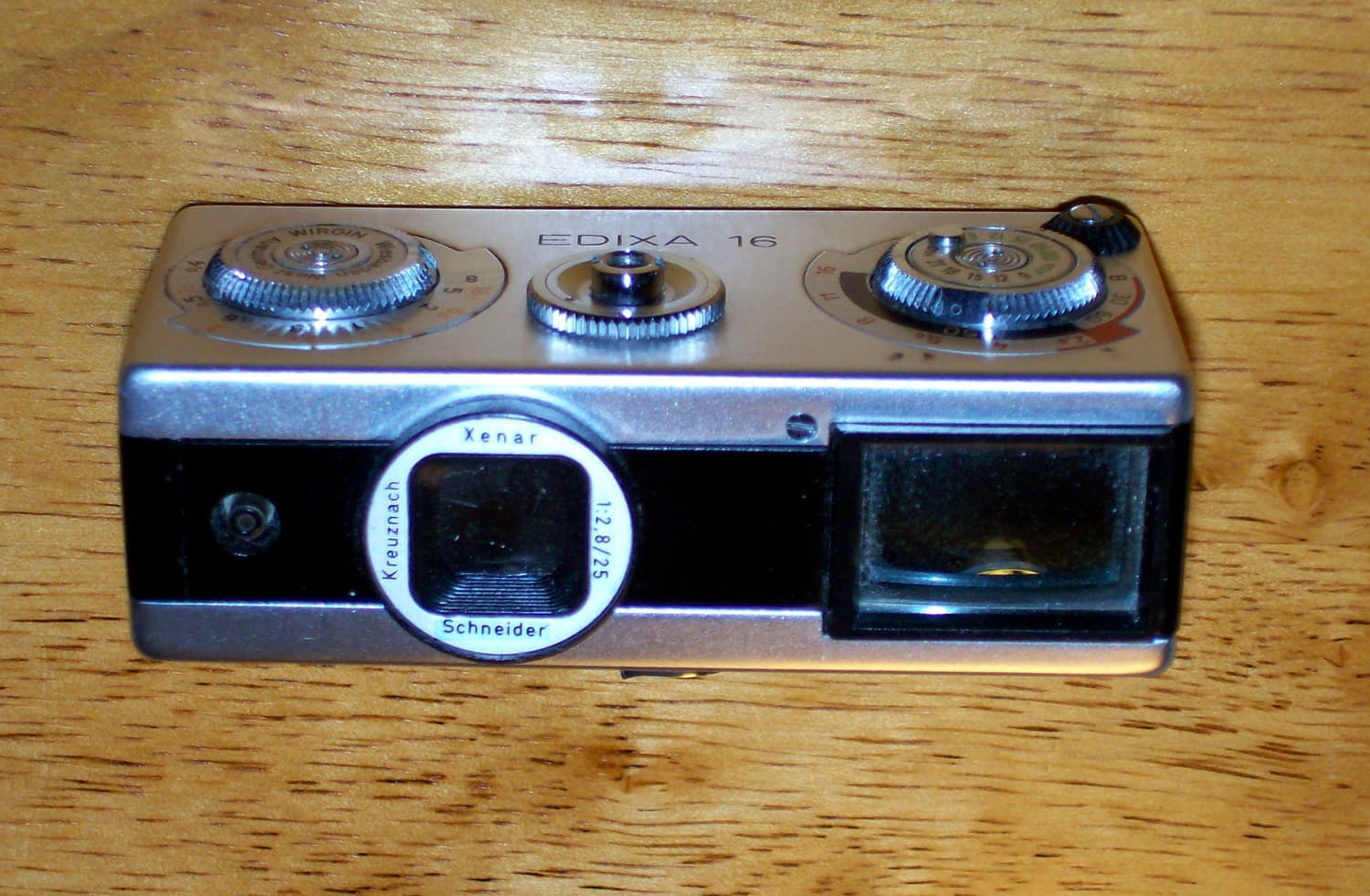
The Wirgin Edixa 16 is a German 16mm subminiature camera introduced around 1960 by Wirgin GmbH of Frankfurt. It was positioned in the so-called spy-camera market that flourished during the late 1950s and early 1960s, when small, easily concealable cameras attracted buyers interested in discreet photography for personal, journalistic, and — in popular imagination — clandestine purposes. The camera uses a fixed lens, a simple leaf shutter, and zone focusing, with no built-in meter. It accepts 16mm film loaded in a proprietary drop-in cartridge format. Construction is all-metal with a leatherette covering, representative of the quality tier that West German manufacturers offered to differentiate from cheaper Japanese competitors.
Reference
Recommended film stocks for the 16mm format your camera takes.
C41
Kodak Gold 200 is a daylight-balanced C-41 color negative film with warm color, moderate grain, and a classic consumer-film look.
View profileC41
Fujifilm Superia X-TRA 400 (marketed as Superia 400 in some regions) is an ISO 400 C-41 consumer color negative film in 135 format, one of Fujifilm's most popular consumer films. It delivers warm, vibrant colors with moderate grain and remains in production in some markets.
View profileC41
Develop 16mm film
Labs in our directory that process 16mm film.
Before you buy used
About this camera
A compact German 16mm subminiature from Wirgin, built for inconspicuous street and travel photography.
| Field | Value |
|---|
| Format | 16mm cartridge (subminiature) |
| Mount | Fixed lens |
| Years | ~1960 - ~1965 |
| Lens | ~25mm f/2.8 |
| Shutter | ~1/25s - 1/200s + B, leaf |
| Flash sync | ~ |
| Meter | None |
| Modes | Manual |
| Weight | ~95 g |
| Battery | None required |
Wirgin was established in Frankfurt in the 1920s and built a reputation for competently made cameras at accessible prices under the Edixa brand name. The company entered the subminiature segment relatively late, after the Japanese market had already produced numerous 16mm designs from Minolta, Mamiya, and Ricoh. Wirgin's Edixa 16 competed on build quality and the prestige of German manufacture, two attributes that carried genuine commercial weight in export markets during the early 1960s.
Wirgin produced the Edixa 16 in at least one variant, the Edixa 16M, which added a built-in meter or other refinements. The company's subminiature output was modest compared to its standard-format Edixa SLR line, and the 16 series was discontinued as the subminiature market contracted in the mid-to-late 1960s. Wirgin itself ceased camera production around 1967 as Japanese competition overwhelmed the mid-tier German market.
The Edixa 16 represents the West German response to Japanese dominance in the subminiature category. Where Japanese makers competed heavily on price and feature density, Wirgin emphasized build quality and the cultural cachet of German optics and engineering. The camera was marketed throughout Europe and exported to North America, where it found buyers among the same consumers drawn to Minox and Rollei products.
For collectors, the Edixa 16 occupies a secondary tier below Minox in perceived value but above purely utility-grade Japanese subminiatures of the era. Its relative scarcity outside Europe makes it a find in North American markets.
Kodak UltraMax 400 is a versatile consumer-grade ISO 400 daylight-balanced color negative film with T-grain emulsion, delivering warm Kodak colors, fine-for-speed grain (PGI 46), and wide exposure latitude. Currently in production and available globally as a single-roll and multi-pack.
BW
Ilford HP5 Plus is a flexible ISO 400 black-and-white film with classic grain and strong push-processing tolerance.
View profileC41
Kodak Portra 400 is a professional C-41 color negative film known for flexible exposure latitude, natural skin tones, and fine grain.
View profileBW
Kodak Tri-X 400 is a classic black-and-white film known for strong tonality, visible grain, and documentary character.
View profile