C41
Kodak Gold 200
Kodak Gold 200 is a daylight-balanced C-41 color negative film with warm color, moderate grain, and a classic consumer-film look.
View profileHalf-Frame
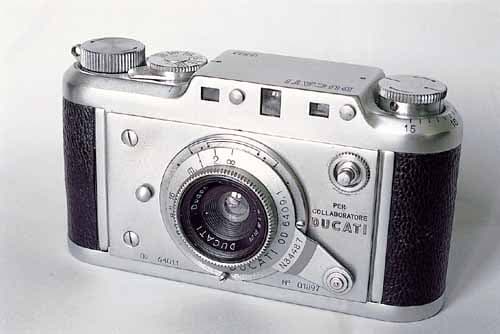
The Ducati Sogno is one of the most unusual Italian cameras of the postwar era. Produced in 1947 by Società Scientifica Radio Brevetti Ducati of Bologna, it predates the company's decisive pivot to motorcycles and represents a brief, ambitious period when Ducati manufactured precision consumer goods ranging from radios to cameras. The Sogno - Italian for "dream" - exposes 18x24mm frames on standard 35mm film, making it a true half-frame camera in the sense that each frame occupies roughly half the area of a standard 24x36mm exposure.
Reference
Recommended film stocks for the half-frame-35mm format your camera takes.
C41
Kodak Gold 200 is a daylight-balanced C-41 color negative film with warm color, moderate grain, and a classic consumer-film look.
View profileC41
Fujifilm Superia X-TRA 400 (marketed as Superia 400 in some regions) is an ISO 400 C-41 consumer color negative film in 135 format, one of Fujifilm's most popular consumer films. It delivers warm, vibrant colors with moderate grain and remains in production in some markets.
View profileC41
Develop half-frame-35mm film
We're growing the lab directory near you. Browse all labs.
Before you buy used
About this camera
Italy's postwar sub-miniature curiosity: an 18x24mm half-frame camera from the company better known for motorcycles.
| Field | Value |
|---|
| Format | Half-frame 35mm (18x24mm) |
| Mount | Fixed lens |
| Year | ~1947 |
| Shutter | Leaf (speeds ~) |
| Meter | None |
| Focus | Scale focus |
| Viewfinder | Direct optical |
| Battery | None required |
Ducati was founded in 1926 in Bologna as a manufacturer of radio components. By the late 1930s the company had diversified into a range of precision products. The postwar period saw Ducati attempt to build a consumer goods business that included the Cucciolo motorized bicycle attachment (which eventually led to the full motorcycle line) and a short-lived camera program.
The Sogno appears to have been produced in very limited numbers around 1947. It is unclear whether production continued beyond that year or whether the camera was ever widely distributed commercially, as surviving documentation is sparse. By the early 1950s Ducati's direction was firmly set toward motorcycles, and the camera line was quietly abandoned. The Sogno thus represents a historical curiosity: a camera made by an engineering company whose name would go on to global fame in an entirely different field.
The Sogno matters primarily as a historical artifact. It demonstrates that the half-frame format predates the well-known Japanese half-frame boom of the 1960s (led by the Olympus Pen series) by over a decade. Italian manufacturers in the immediate postwar period experimented with compact, economical camera formats in response to film scarcity and the need to maximize exposures per roll - a practical consideration in austerity-era Europe.
As a photographic instrument the Sogno is too rare and fragile to be a working photographer's tool today. Its significance is archival: it documents a period of Italian industrial history when precision engineering firms briefly turned their skills toward consumer optics and photographic equipment before market pressures concentrated camera production in Germany and Japan.
Kodak UltraMax 400 is a versatile consumer-grade ISO 400 daylight-balanced color negative film with T-grain emulsion, delivering warm Kodak colors, fine-for-speed grain (PGI 46), and wide exposure latitude. Currently in production and available globally as a single-roll and multi-pack.
BW
Ilford HP5 Plus is a flexible ISO 400 black-and-white film with classic grain and strong push-processing tolerance.
View profileC41
Kodak Portra 400 is a professional C-41 color negative film known for flexible exposure latitude, natural skin tones, and fine grain.
View profileBW
Kodak Tri-X 400 is a classic black-and-white film known for strong tonality, visible grain, and documentary character.
View profile