C41
Kodak Portra 400
Kodak Portra 400 is a professional C-41 color negative film known for flexible exposure latitude, natural skin tones, and fine grain.
View profile35mm Compact
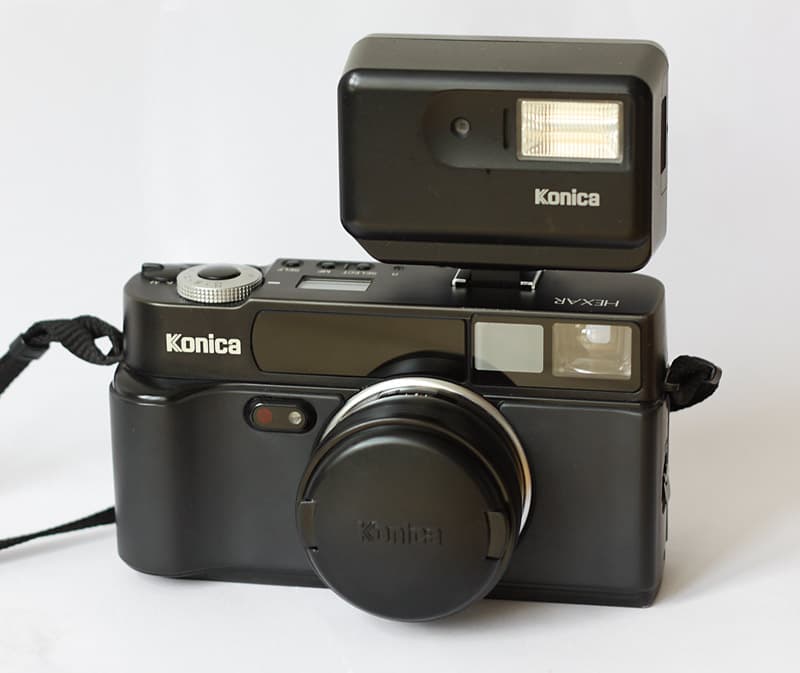
The Konica Hexar AF Black (1993) is the all-black-finish limited variant of the Konica Hexar AF autofocus compact. The specification is identical to the standard Hexar AF: **Konica Hexanon 35mm f/2** fixed lens (7 elements, 6 groups), hybrid passive/active autofocus, electronic leaf shutter (30s-1/250s) syncing flash at all speeds, aperture-priority and program modes, and the trademark **silent mode** that reduces shutter and film-advance noise to near-inaudible levels. The black finish - a uniform matte black over the polycarbonate-on-aluminum chassis, including the lens barrel, which on the standard model carries a chromed ring - was produced in limited quantities and sold at a premium over the standard black and silver variants.
Reference
Recommended film stocks for the 35mm format your camera takes.
C41
Kodak Portra 400 is a professional C-41 color negative film known for flexible exposure latitude, natural skin tones, and fine grain.
View profileC41
Kodak Gold 200 is a daylight-balanced C-41 color negative film with warm color, moderate grain, and a classic consumer-film look.
View profileC41
Fujifilm Superia X-TRA 400 (marketed as Superia 400 in some regions) is an ISO 400 C-41 consumer color negative film in 135 format, one of Fujifilm's most popular consumer films. It delivers warm, vibrant colors with moderate grain and remains in production in some markets.
Develop 35mm film
Labs in our directory that process 35mm film.
Before you buy used
About this camera
All-black Hexar AF with premium finish - the same Hexanon 35/2 and silent shutter in a uniform matte-black body released as the limited prestige variant.
| Field | Value |
|---|
| Format | 35mm |
| Lens | Konica Hexanon 35mm f/2, 7 elements / 6 groups |
| Years | 1993 - ~2003 |
| Shutter | 30s - 1/250s, electronic leaf |
| Flash sync | All speeds (leaf shutter) |
| Meter | Center-weighted silicon |
| EV range | EV -1 - EV 17 |
| Modes | Aperture priority, program, manual-distance |
| Weight | 490 g |
| Battery | 1x CR123A |
| Silent mode | Yes |
Konica launched the Hexar AF in 1993 in two primary finishes: a standard black body with chromed lens-barrel trim and a silver-finish version. The all-black "Black" variant - with the chrome trim replaced by black-lacquered or anodized equivalents for a uniform stealthy appearance - was produced in smaller numbers as a premium offering. Over the camera's production life (1993-~2003), Konica issued additional cosmetic variants including Hexar Classic (chrome and leatherette), Hexar Rhodium, and Hexar Gold, the last two in very small quantities.
The all-black finish convention has a long precedent in photojournalism culture: black-body Leicas, black-finish Nikons, and black Contaxes were seen as less conspicuous and more serious than chrome versions. The Hexar AF Black tapped into this preference. Production quantities for the Black variant specifically are not publicly documented.
Konica merged with Minolta in 2003, ending independent Konica camera production. All Hexar AF variants were discontinued at that point.
For practical photography, the Hexar AF Black is identical to the standard Hexar AF: the Hexanon 35/2 lens, silent mode, and leaf shutter are the value. The black finish matters primarily on two fronts: discretion (a uniform black body is less reflective and less visually prominent in street or documentary work) and collectability (limited-run variants with coherent premium finishes hold value better in the secondary market).
In 2026, clean examples of the Hexar AF Black command a meaningful premium over standard black Hexar AF examples, reflecting both lower original production volume and collector demand. The camera still underprices the Contax T2 ($1,800 floor) while offering a faster lens (f/2 vs f/2.8) and a larger, more comfortable body. The silent mode remains practically useful - slower film advance means quieter shooting in library, court, or performance contexts where mechanical camera noise is an issue.
The Hexanon 35/2 optical formula (7 elements, 6 groups) produces a rendering character distinct from the T2's Zeiss T* Sonnar: warmer, with more open mid-shadow values and slightly less clinical sharpness wide open. Neither is objectively superior; the difference is a matter of taste and shooting style.
Lens fixed. No interchangeable mount.
Accessories:
C41
Kodak UltraMax 400 is a versatile consumer-grade ISO 400 daylight-balanced color negative film with T-grain emulsion, delivering warm Kodak colors, fine-for-speed grain (PGI 46), and wide exposure latitude. Currently in production and available globally as a single-roll and multi-pack.
View profileC41
Kodak ColorPlus 200 is an affordable, consumer-oriented daylight-balanced color negative film at ISO 200. Known for warm, slightly muted color rendition, fine grain, and wide exposure latitude, it is currently in production and widely available in Asia and select global markets.
View profileBW
Kodak Tri-X 400 is a classic black-and-white film known for strong tonality, visible grain, and documentary character.
View profile